

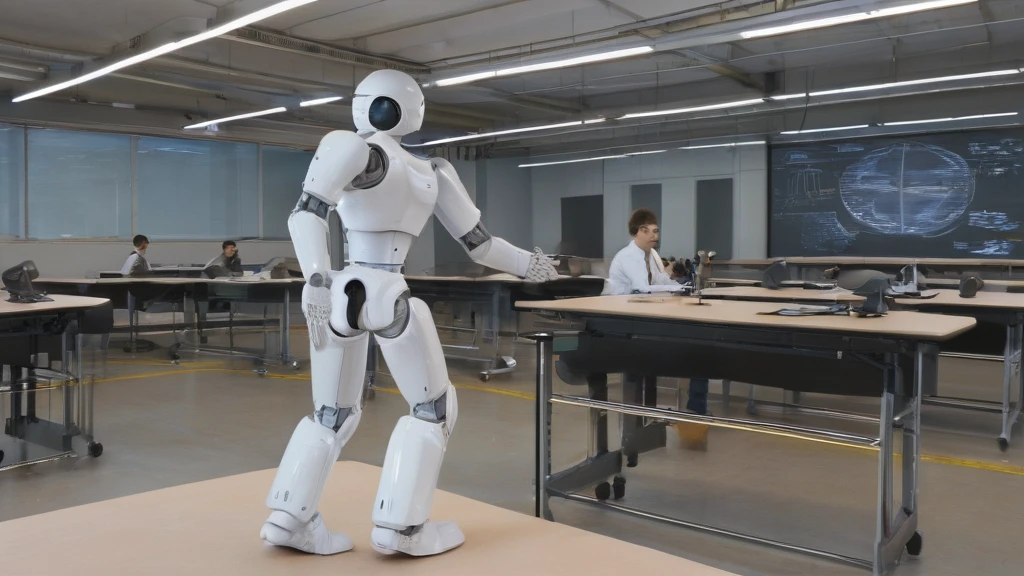
RIG Lecture Series: A new form of education in robotics
The launch of the RIG Lecture Series marks a new phase in promoting knowledge and collaboration between academia and industry. Starting October 29, 2026, every Thursday from 14:15 to 15:45, participants can observe lectures given by experts from institutions such as MPI-IS, Fraunhofer IPA, and TU Berlin. The series includes twelve sessions and aims not only to impart knowledge but also to build bridges between research, teaching, and society.
related to industry. All lectures are conducted in English, ensuring access for the international scientific community and practitioners from various countries. An important element of the series is its openness - it is not limited to universities. Anyone interested can join, even if they are not a student. This allows for broad dissemination of knowledge and promotes dialogue between different groups: researchers, engineers, entrepreneurs, and the public. All lectures are recorded and available after the cycle is completed, allowing participants to re-watch the materials and further study the topics.
Lectures cover a wide range of issues - from medical robotics and supporting people in multi-robot systems, industrial robotics, and autonomous control. Among the announced topics are: m.in- analysis of social signals, microrobotics in medicine, learning from the environment, and integration of AI in production systems. Each lecture is not only a presentation of research results but also an opportunity to ask questions and interact directly with representatives of research institutions.
Why participate in RIG lectures?
 Enlarged imageClose zoomPrevious image
The development of robotics is not limited to technological innovations - it is also a matter of education, collaboration, and knowledge transfer. The RIG Lecture Series offers a unique opportunity for direct access to the latest research findings without having to attend conferences or publish scientific papers. For students, this is an opportunity to understand how theory translates into practice, and for engineers - to learn about new approaches to solving problems in industry and medicine. Many topics concern the integration of artificial intelligence with robotics, which is crucial for the future of automation.
materials after the lecture. Recordings are published on the RIG website, allowing participants to re-watch and study the topics at any time. This is especially useful for people in different time zones or those who cannot participate in real time. All lectures are conducted in English, ensuring global access and promoting international collaboration. For universities and research institutions, this is also a way to raise their profile and increase visibility within the scientific community.
Thematic scope: from perception to industrial robotics
The lecture series covers a wide range of fields that shape modern robotics. Among the announced topics are: lectures cover topics such as social signal analysis by robots, the development of humanoids for industrial applications, learning robot control in dynamic environments, and microrobotics in medicine. They also address the integration of AI in production and logistics systems, which is crucial for Industry 4.0. All topics are current and reflect the latest research trends.
which are becoming increasingly important in the context of growing dependence on automation. The lectures promote a balanced approach: not only technological innovations, but also their ethical and practical aspects. This allows for the development of robotics not only as a tool, but as an element supporting people in everyday life and work. For participants, it is an opportunity to understand the complex challenges of modern robotics - from technical to social ones.
Availability and participation: how to join?
Joining the RIG Lecture Series is easy. Simply register using the link to the session on the Zoom platform, which has been provided on the organizer's website. The meetings take place every week on Thursday from 14:15 to 15:45, and the number of participants is limited due to technical constraints. Therefore, it is worth registering in advance to secure a place. After the cycle is completed, all lectures are available in the form of recorded materials on the RIG website. They can be viewed at any time and from anywhere - ideal for repeated study or sharing knowledge with others.
- it is also an environment that supports the exchange of ideas, creativity and innovation. For those interested in robotics, whether as scientists, engineers or students, the RIG Lecture Series offers a unique opportunity to participate in the latest research events without having to be in the same place as the experts. This is the future of education - accessible, flexible and global. Interested parties can also follow the news on the RIG website and subscribe to the newsletter to receive information about upcoming events and new initiatives in the field of robotics.