
Pilot program of humanoid robots in agricultural production
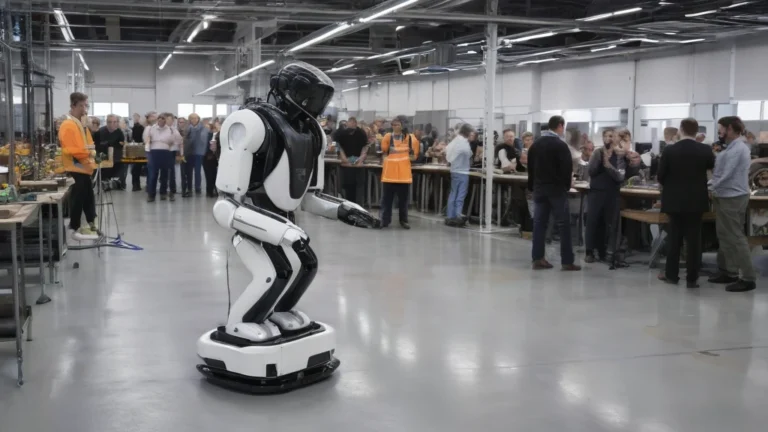
AGCO, a global leader in the agricultural machinery industry, has partnered with Agility Robotics to test a humanoid robot. of the Digit robot® at its manufacturing facility in Hesston, Kansas. This is not the first instance of such a robot being used in industry - AGCO joins the group of global companies that are already implementing solutions from Agility Robotics., GXO, and Schaeffler. The pilot project is scheduled to begin in 2027 and will focus on assembly and logistics operations within the production line.
The aim of the project is not only to increase production efficiency but also to improve working conditions. Automating repetitive and physically demanding tasks should reduce worker strain, which translates into better ergonomics and safety. In this context, the robot is not intended as a replacement for humans, but as a partner - supporting people in difficult tasks, allowing them to focus on more valuable and innovative activities.
An advantage of the solution is its flexibility. The Digit® robot operates on advanced artificial intelligence and continuously learns new work procedures in changing conditions. This allows it to adapt to different scenarios without the need for extensive programming. Collaboration with the Agility Arc™ platform enables rapid deployment of robots without the need for costly plant upgrades, which is crucial for companies wanting to invest in new technologies without interrupting production.
Robots as partners, not replacements for people
 Enlarged imageClose zoomPrevious image
AGCO emphasizes that humanoid robots are not intended for complete automation, but to support human work. In a statement, Thomas Enghof, AGCO's director of manufacturing technology, said that robots should be treated as "partners" in building smart factories. Their task is to take over repetitive, physically strenuous or potentially dangerous tasks - such as lifting heavy objects or working in high-temperature conditions. This allows people to focus on tasks requiring creativity, problem-solving and innovation.
This approach reflects a new phase of robotics - not about replacing humans, but about empowering them. The Digit® robot is not just a tool for automation, but an element of a system that supports human potential. In this context, safety and control are key. Agility Robotics emphasizes that the robot operates in accordance with leading safety standards and has already accumulated over 65,000 hours of operation in real-world conditions.
It is also important to understand that this is not a mass deployment. The pilot program in Hesston is a testing phase designed to help assess the effectiveness of the solution in a real production environment. The results of this experiment may influence decisions about expanding the use of robots in other AGCO plants or even in other industries, but for now there is no information about plans for implementation beyond this one location and time. This is a demonstration of capabilities, not a ready-made product for sale.
Advanced technology, but limited to specific tasks.
The Digit® robot operates on advanced artificial intelligence and can learn in real time. This allows it to adapt to changing working conditions, such as different configurations of storage areas or changes in the location of elements. However, its functions are limited to tasks that have been previously designed and tested - it is not a general-purpose robot in the full sense. It still requires strictly defined operating conditions, such as a stable floor structure, access to power, and adequate lighting.
In addition, although the robot can operate without the need for expensive modifications to the plant thanks to the Agility Arc™ platform, its efficiency depends on the quality of input data and the accuracy of AI models. If working conditions change significantly - e.g., new types of bags or unforeseen obstacles - it may require operator intervention or recalibration. This means that the robot is not yet able to operate completely autonomously in dynamic and non-standard environments.
It is also worth noting that AGCO is not the first company testing such solutions - robots of this type are already being used by other industrial companies. However, their integration into agricultural machinery production, where ergonomic and logistical requirements are high, is a new step. The pilot in Hesston may become an important point of reference for other companies in the industrial sector that are looking for ways to improve efficiency without full automation.
Perspectives and limitations of the pilot program.
The pilot program in Hesston, Kansas, is intended to be one of the first cases of using a humanoid robot in the production of agricultural machinery. Although the company has not provided detailed results or measurable goals, its statement indicates long-term goals: building flexible, intelligent factories that can quickly respond to market changes. In this context, the robot is not just a tool for reducing costs, but an element of an innovative strategy.
However, it should be remembered that this is a pilot program - not a full-scale implementation. There is no information about the number of robots, their location in the plant, or plans for development after 2027. All advantages and limitations will only be known after the tests are completed. For now, it is impossible to talk about the future of AGCO's production without humanoid robots - this is just one of the possible paths of development, which may be confirmed or rejected based on the results of the experiment.
It is also important to look beyond technology. The introduction of a humanoid robot in a manufacturing plant is not only a technical issue but also a human one - it requires a change in work culture, trust in machines, and new safety procedures. Therefore, the pilot program is also intended to be a social test: how employees accept cooperation with the robot, whether they feel safer, or whether their skills increase. These aspects may be just as important for the success of the project as the technical parameters.