

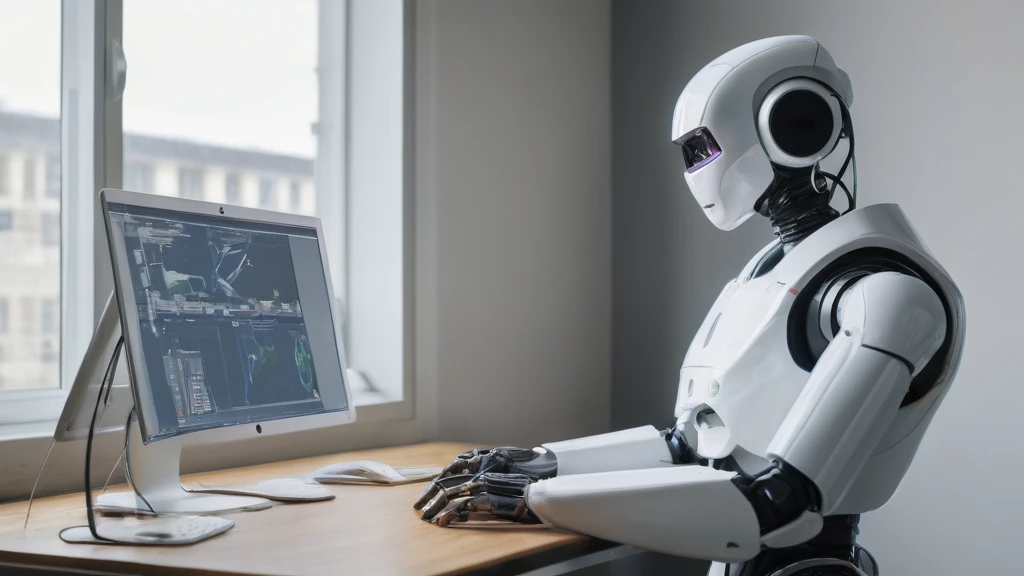
Record market value and new technological opportunities
Market value of installations industrial robots reached a record $16.7 billion. This is not only an indicator of technological development, but also a signal for companies that investments in automation are not only justified, but necessary. In the future, growth in demand will be driven by technological innovations, market forces and new areas of activity. A key factor is the development of artificial intelligence, which allows robots to operate not only according to established rules, but also to make decisions in real time.
In particular, AI analysis enables the processing of large data sets, the detection of patterns and the provision of active guidance. This allows robots to independently predict failures before they occur - for example, in smart factories - or to optimize routes and resource allocation in logistics. These capabilities are changing the way robot systems are used: not only as tools for repetitive tasks, but as elements of an intelligent production ecosystem.
IT and OT integration - the key to robot flexibility
The increasing need for flexible industrial solutions is leading to a deeper integration of information technology (IT) with operational technology (OT). This convergence allows for the combination of IT data processing power with OT physical control, which significantly enhances the capabilities of robots. This makes it possible to continuously transmit data in real time, automate processes and perform advanced data analysis.
IT/OT integration is the foundation of the digital enterprise and the transition to Industry 4.0. Removing the isolation between the digital and physical worlds enables seamless information exchange, which translates into faster reactions to changes in production, better quality and greater efficiency. In practice, this means that a robot can not only perform a task, but also analyze its effective execution and adapt to new conditions without human intervention.
Humanoid robots - from prototype to real-world application
The field of humanoid robotics is rapidly expanding. Although initially these were experiments, today companies and researchers are moving from prototypes to real-world deployments in warehouses and factories. A key condition for success is the ability of these systems to operate according to industrial requirements: working cycle, energy consumption, maintenance costs.
To compete effectively in human-centric environments, humanoid robots must achieve a level of dexterity and productivity comparable to humans. This is not just a technical issue - it also requires meeting safety standards, durability, and consistent performance on the production line. Without this, their role as an alternative to traditional automation systems will remain limited.
Safety and digital protection - new challenges
The increasing autonomy of robots, especially when combined with AI and cloud connectivity, leads to growing security threats. Experts note an increase in the number of cyberattacks targeting robot controllers and cloud platforms - which allows for unauthorized access and system manipulation.
In addition, growing concerns relate to data collected by robots: video, audio, sensor data. In the case of deep learning models, which are often referred to as "black boxes", the results may be difficult to explain even for the creators. This leads to the need for clear legal and ethical frameworks, especially in the context of responsibility for the actions of an AI system.
Robots as partners - the key to acceptance
The introduction of robots should not be a one-sided process. A key factor for success is collaboration with employees during implementation. This cooperation is essential for the acceptance of technology - both in industry and services.
Robots are not only a solution to labor shortages, but also a tool to relieve employees from repetitive tasks. In this way, new career opportunities open up, and the workplace becomes more attractive to young professionals. Therefore, companies and governments support training programs that help employees adapt to changing labor market requirements.