

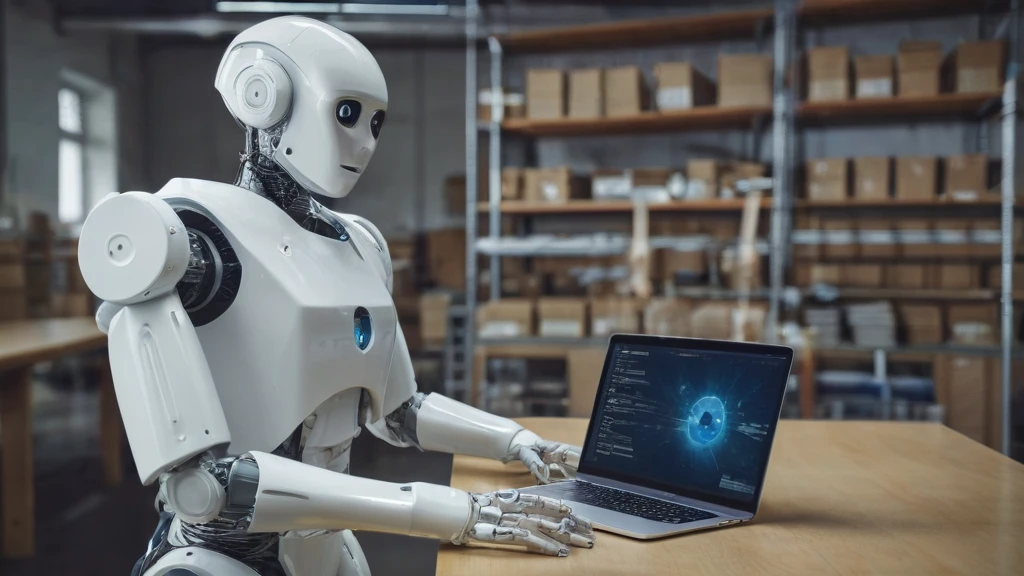
Robots in manufacturing: from efficiency to a sustainable economy
The support of production processes by robots is not limited to increasing efficiency. Thanks to their accuracy and stability, production becomes more efficient - less waste, lower defect rates and reduced energy consumption. This directly supports UN Goal No. 12: ensuring sustainable consumption and production patterns. The introduction of robotics in local production centers makes it possible to reduce energy consumption related to transport, which translates into lower CO₂ emissions. This approach also supports the economic development of developing countries by improving the quality and competitiveness of their products.
An important aspect is also workplace safety. Robots take over dirty, monotonous and dangerous tasks - which contributes to creating more inclusive work environments. An example is supporting employees with disabilities or older employees in industrial plants. This not only improves working conditions, but also supports SDG 8 (sustainable economic growth) and SDG 9 (resilient infrastructure and innovation).
Environmental protection: from recycling to ecosystem protection
Robots play a key role in environmental protection, especially in areas such as recycling and waste management. Thanks to material recognition technology, robots can precisely identify the type of plastic, which significantly improves sorting efficiency. In some cases, they are used for 3D printing with renewable materials - which opens up new possibilities in sustainable production. This directly supports SDG 12 and SDG 13 (climate action).
In the area of underwater ecosystem protection, robots are used to inspect pipelines on oil platforms, clean aquaculture farms or recover plastic from oceans. In agriculture and forestry, robots help reduce the use of chemical fertilizers and pesticides, which counteracts soil degradation and erosion. This supports SDG 14 (ocean protection) and SDG 15 (terrestrial ecosystem protection).
Health, education and access to services - robots in social sectors
 Enlarged imageClose zoomPrevious image
In medicine, robots support doctors and nurses in their daily work. They help with patient transport, reduce administrative burden and assist in drug testing. The most significant application is robotic surgery - where the precision and repeatability of devices translate into lower risk of complications and faster healing of patients. This directly supports SDG 3 (good health and well-being).
In education, robots are used to support STEM learning - especially in technical schools and universities. They enable a practical approach to learning programming, engineering, and automation. In this way, they contribute to promoting gender equality (SDG 5) by enabling women and girls to access technology in environments that were previously dominated by men.
Context and limitations: where robots can help, and where they cannot.
Although the development of robotics brings real benefits for sustainable development, its impact is limited by infrastructure, access to energy, and ethical issues. In many developing countries, there is a lack of basic electrical or communication networks that are necessary for the operation of advanced robotic systems. Furthermore, although robots can support employment, their implementation may lead to structural changes in the labor market - which requires appropriate training programs and social policies.
It is also important to distinguish between potential and actual implementation. Many of the examples given in the report relate to demonstrations, tests, or pilots - not mass deployment. This means that although the technology works, its scaling on a global level still requires time and investment.
It is worth emphasizing that although robots support many sustainable development goals, their impact is not automatic or unconditional. The introduction of technology requires an appropriate approach: from investments in infrastructure and access to energy to employee training and ethical regulations. Without these conditions, even the most advanced solutions may remain unused, especially in countries with a lower level of economic development. Furthermore, although robots can replace people in difficult and dangerous tasks, their role should be complementary - supporting human work rather than completely replacing it.
This is what primarily allows maintaining a balance between innovation and social justice, which is crucial for long-term success in achieving the SDGs. In a global context, the development of robotics must be sustainable not only from an environmental but also from a social and economic perspective - which means that its potential can only be realized when it is supported by policies, education, and intergenerational partnerships.