
A new stage in industrial robotics: a humanoid with an autonomous agent
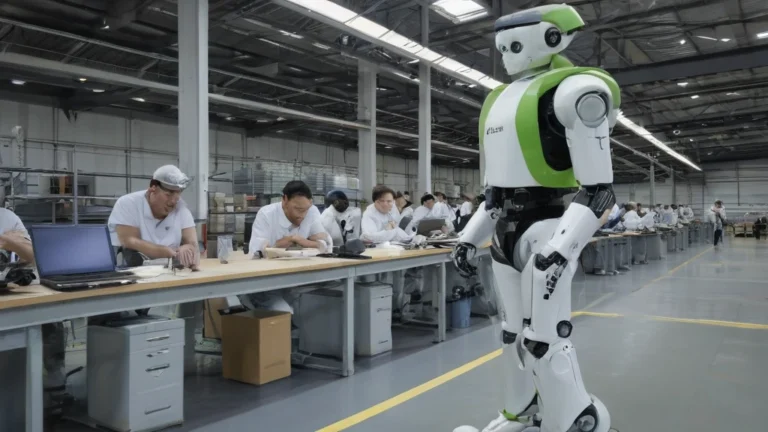
Cruzr Y1 is the first of its kind industrial humanoid, which not only performs tasks but also makes decisions based on its own Co-Agent system. According to the manufacturer's statement, this agent is the first in the industrial world designed specifically for humanoid robots. Its goal is to move from simple, repetitive actions to full autonomy in dynamic factory conditions.
Unlike traditional ones industrial robots, which require precise programming for each scenario, Cruzr Y1 has the ability to adapt. This is not just software supporting work - it is a new concept of an "evolving" robot that learns and reacts to changes in the environment without the need for operator intervention.
Four key work scenarios: from packing to machine tending
Cruzr Y1 was designed to handle four of the most common and costly tasks in industry. The first of these is autonomous palletizing - the robot can automatically adjust the size of the packaging to the load, which eliminates the need for manual adjustment or downtime when changing batches.
The second scenario is precise sorting of materials - even if they are disorganized, mixed or irregular. This means that the robot can work in the conditions of a real factory, where the material does not always arrive perfectly arranged.
The third area is machine tending - automatic loading and unloading of CNC or forming machines. The robot synchronizes with the production cycle, which allows for continuous operation of the line without the need for breaks.
The fourth, and most important, is resilience to chaos - the system can detect a shift or fall of the load and automatically correct it. According to the manufacturer's statement, this ensures zero downtime.
 Enlarged imageClose zoomPrevious image
Is this already a real implementation or just a demonstration?
In UBTECH's documentation, no information is provided about specific implementations, pilots, or tests in a real factory. All descriptions are presented as technological declarations and product advantages. There is also no data on whether the robot has already been installed at a customer's site or tested in real conditions.
This means that currently Cruzr Y1 remains at the stage of a technology presentation. Although its functions are well described and seem realistic, there is a lack of independent confirmations or data from real-world applications. Therefore, it should be treated as an advanced demonstration of capabilities, rather than a documented implementation.
Significance for the industry: can a humanoid replace humans?
The introduction of an industrial humanoid with such a high level of autonomy may change the approach to automation. If the system actually works as described, it not only reduces the need for manual intervention but also allows for faster transitions between different types of production - e.g., from one type of product to another without long downtimes.
However, the key limitation remains the lack of data confirming its effectiveness in real-world conditions. Many technologies that seem revolutionary at a presentation do not stand the test of time and real factory conditions - especially when it comes to interacting with non-standard materials or dynamic changes in the process.
Therefore, it is worth treating Cruzr Y1 as a potential step forward, but not as a ready-made solution for mass implementation. Its true value will only be visible after actual tests and implementations.
Prospects: what's next for industrial humanoids?
If UBTECH manages to demonstrate the effectiveness of Cruzr Y1 in real conditions, it may open the way for a new generation of industrial robots - not only mobile but also humanoid and capable of full autonomy. This would mean a transition from process automation to decision automation.
However, this requires not only advanced algorithms but also stability, error resistance, and predictable operation. Currently, there is a lack of data confirming that Cruzr Y1 meets these criteria in practice.
Therefore, the most important step will be not a presentation but actual implementation - both for customers and for technical analysis. Only then can it be assessed whether this is a new era of industrial robotics or just another technological demonstration.