

What is the Greve Award and why is it important?
The Greve Award is one of the most important scientific awards in Germany, awarded every two years by the German National Academy of Sciences Leopoldina. In 2026, its value was 250 thousand euros and it was intended to recognize achievements in robotics and embodied intelligence. This is not the first time that the award has concerned robotics - previously it was awarded for work in industrial or autonomous systems.
The valuable significance of the award lies not only in financial support, but also in recognizing the international impact of research. The awarding of the Greve Award to Prof. Asfour emphasizes the growing role of Germany in humanoid robotics research and confirms that work on intelligent systems can have real applications outside the laboratory. This is not just recognition for one person - it is a signal to the entire scientific community about the key importance of the concept of embodied intelligence in the future of robotics.
Research area: integration of perception, motion and learning.
 Enlarged imageClose zoomPrevious image
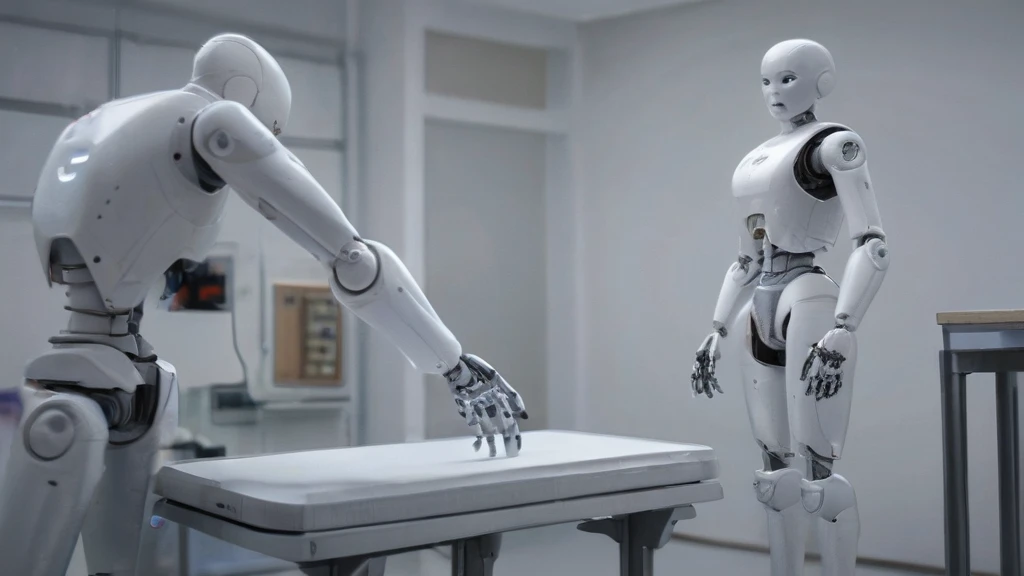
Prof. Tamim Asfour's research focuses on creating robots that not only perform pre-defined tasks, but can also adapt to a changing environment. A key element is the integration of four areas: perception (how the robot sees and hears), motion control (how it moves in space), manipulation (how it holds objects) and learning (how it acquires new skills based on experience). This integration allows robots to perform complex, non-standard tasks in the real world - e.g. setting a table, handing over tools or helping around the house.
The research results are based on the ARMAR family of robots, which have been developed for over 25 years. These are not only a series of experimental devices - they are a research platform that allows testing new algorithms and system architectures. Work on ARMAR shows that the development of humanoid robotics requires long-term commitment, and not just one-off projects. Therefore, the Greve Award is not only recognition for one person, but also for the model of cooperation between a university (KIT) and a research institute (RIG).
Significance for the future of robotics and practical applications
The awarding of the Greve Prize to Professor Asfour is not just an act of recognition - it is a signal to investors, companies and institutions that humanoid robotics can be the future. Research on embodied intelligence has the potential to transform sectors such as healthcare, logistics or manufacturing. If a robot can not only perform a task but also learn from mistakes and adapt to new conditions, it can be used in places where people are at risk or where there is a shortage of workers.
It is worth emphasizing that the award does not yet mean mass implementation. of humanoid robots.This is not a pilot project, demonstration or commercialization - it is scientific recognition for long-term research contributions. Practical applications may only appear after several more years of technology development and cost reduction. However, even today, such research creates the foundations for systems that will be able to support people in their daily activities - not replacing them, but making work easier.
Limitations and development prospects
Although the award highlights progress in humanoid robotics, it does not mean that robots are yet ready for full autonomy in complex environments. Current systems, despite advanced integration of perception and learning, still have limitations in terms of error resistance, reaction speed or ability to reason in unforeseen situations. In addition, the costs of producing and maintaining such systems are high - which limits their availability.
The prospects for development are promising: new approaches to learning are being developed, which allow for faster acquisition of skills. Collaboration between research institutions and industry can accelerate technology transfer. However, the key factor remains long-term commitment - as shown by the history of Professor Asfour and his team, who have been working on ARMAR robots for over 25 years. This is not only a technological innovation - it is a scientific culture that builds the future.