
Real-world demonstrations: robotics beyond the laboratory.
During the summer exhibition of the Royal Society in London, which took place from June 30 to July 5. in 2026, participants were able to see how real the challenges associated with robot manipulation in real environments are. Research on embodied intelligence - that is, body intelligence - was presented by a team from the Oxford Robotics Institute, which focuses on creating systems that not only perform tasks but also learn and adapt in real time. The exhibition was part of a larger project funded by EPSRC, which aims to develop intelligent solutions for industry and society.
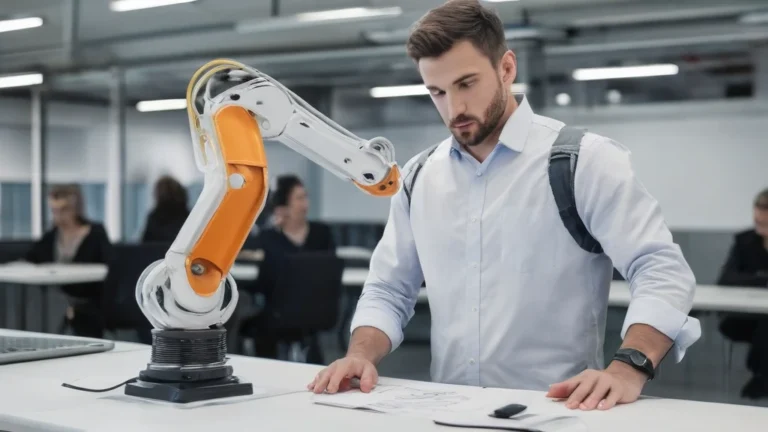
One of the most notable elements of the exhibition was the Frank robot - a two-armed manipulator with advanced learning capabilities. For several days, its actions were controlled remotely by participants who used Meta Quest headsets to view the world from the perspective of the robot's camera. This was not just a technology demonstration - it was an attempt to show how difficult it is for humans and machines to interact in real time. Participants could feel the limitations of the workspace, delays in response, and the difficulties associated with precise coordination of movements.
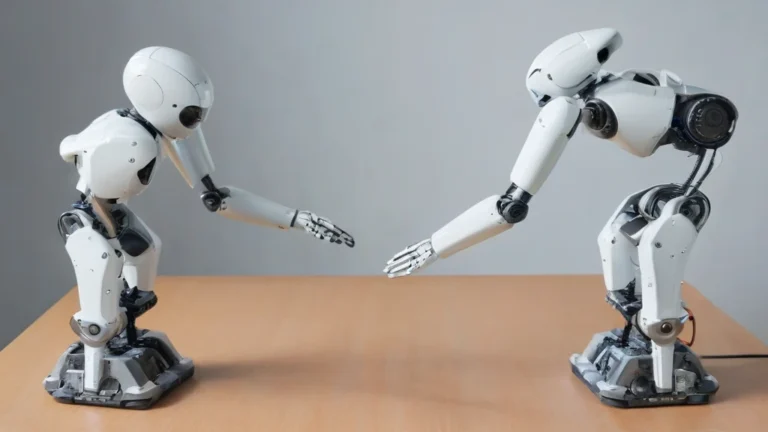
In addition, 3D-printed arms of the S101 robot were presented at the exhibition, where one arm acts as a leading arm and the other as a following arm. The audience could perform tasks such as stacking or arranging blocks, which allowed for a direct visualization of the differences between human and machine approaches to physical manipulation.
What happened during the interactive sessions?
 Enlarged imageClose zoomPrevious image
As part of a public experiment, participants were able to try their hand at a teleoperation simulation. Using a controller similar to the platform used to control a real robot, they tried stacking three blocks on a stand - a task that seems simple for humans. However, most players quickly realized that precisely moving the robot arm, planning movements and controlling distances are not obvious challenges. Only 23% of participants stated that robotics is easy - and 37% admitted that they learned something new.
It was also important how the participants reacted: some were surprised by the effectiveness of the technology, while others were amazed at how much more needs to be done for robots to work not only in a controlled environment but also in real-world conditions - where there is no ideal data or predictable scenarios. The exhibition showed that even simple tasks require complex sensorimotor coordination, which is lacking in current systems.
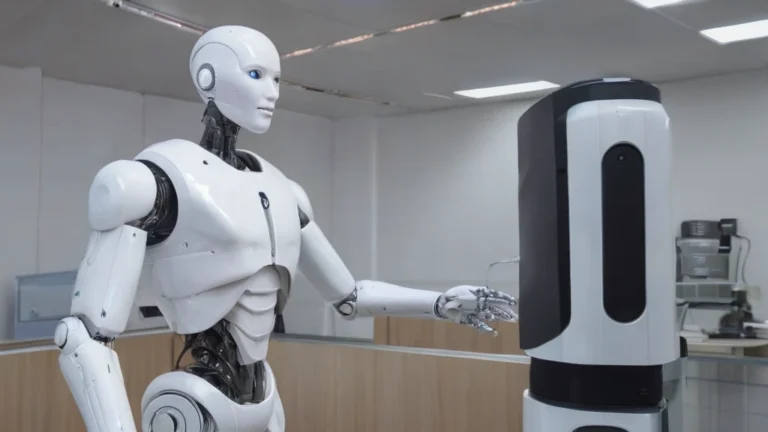
In one of the sessions, several members of the Royal Society had the opportunity to control a real robot named Frank. In another part of the exhibition, participants played a game of noughts and crosses with a robot, which demonstrated the potential for human-machine interaction even in simple forms of communication.
Touch sensors: key to precision in assembly
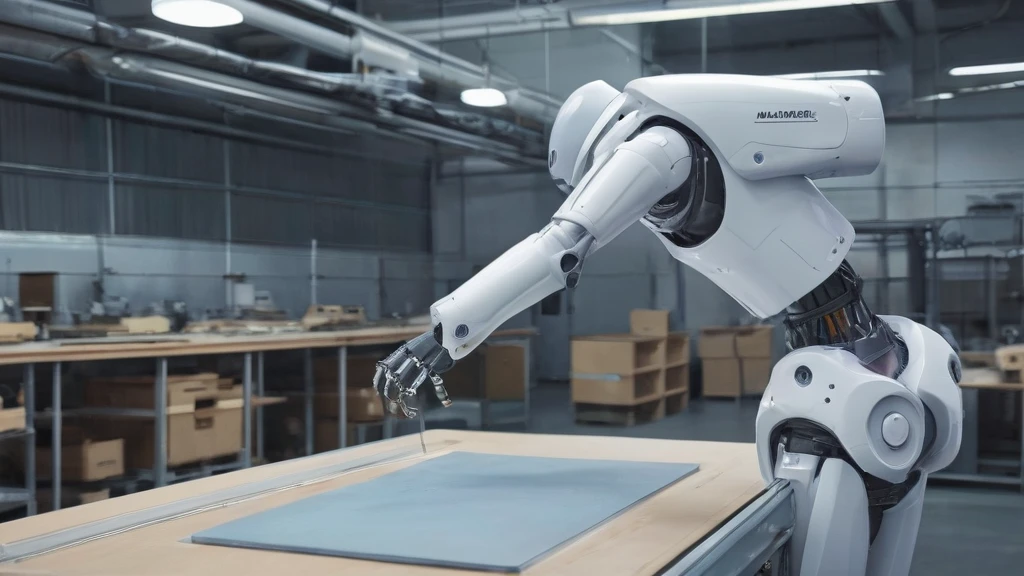
One of the most innovative elements of the exhibition was the soft robotic hand from the Soft Robotics Lab. Built with flexible, sensorized skin, it could detect pressure, texture and contact in real time. This was not just technology - it was a response to a specific problem: how can a robot gently lift a glass ball or assemble a component with a tolerance of a few micrometers without damaging it?
The demonstration showed that touch is not just an additional sensor - it is the foundation of embodied intelligence. Without sensitivity to contact, a robot cannot understand whether it is holding an object too tightly or too loosely. It is these solutions that can bring about changes in small-batch production, where precision and flexibility are key.
Research conducted by Professor Perla Maiolino showed that touch sensors allow for immediate response to changes in the environment. When the hand touches a surface, the system immediately reacts - e.g., reduces grip force if excessive pressure is detected. This approach is crucial for applications in medicine, electronics or precision engineering.
Why is this important for the future of robotics?
The exhibition was not just a presentation of technology - it was an attempt to understand how society perceives robotics. Research shows that despite advances in machine learning and world modeling, there is still a huge gap between theory and practice. Robotics is not yet ready for full autonomy in complex, unpredictable environments - especially where delicacy and adaptation are required.
Therefore, the key step is not only to develop algorithms but also to educate the public. The exhibition showed that when people can try controlling a robot themselves - even in a simple task - they begin to understand its limitations and potential. This may contribute to a more realistic approach to automation in industry.
As Kate Lampo, a doctoral student from the Oxford Robotics Institute, pointed out: "The most satisfying part of the exhibition was meeting diverse guests - from children to non-STEM people. Everyone had a different perspective on robotics and AI: some were optimistic, others skeptical, but most were willing to learn."
What remains unclear?
Although the demonstrations were effective, this does not mean that systems such as Frank or soft hands are ready for mass deployment. The exhibition only showed the experimental stage - a demonstration of possibilities, not a ready-made industrial solution. There is a lack of data on the scale, durability, costs and scalability of these solutions.
Furthermore, although participants understood the difficulty of coordination, this does not fully explain how such systems will perform over time - whether they are resilient to errors or can learn without constant supervision. These questions remain open and require further research.
It is also important that, although robotics is developing rapidly, its implementation in real-world conditions requires not only technology but also new approaches to system design - which take into account human interaction, errors, and environmental variability.