

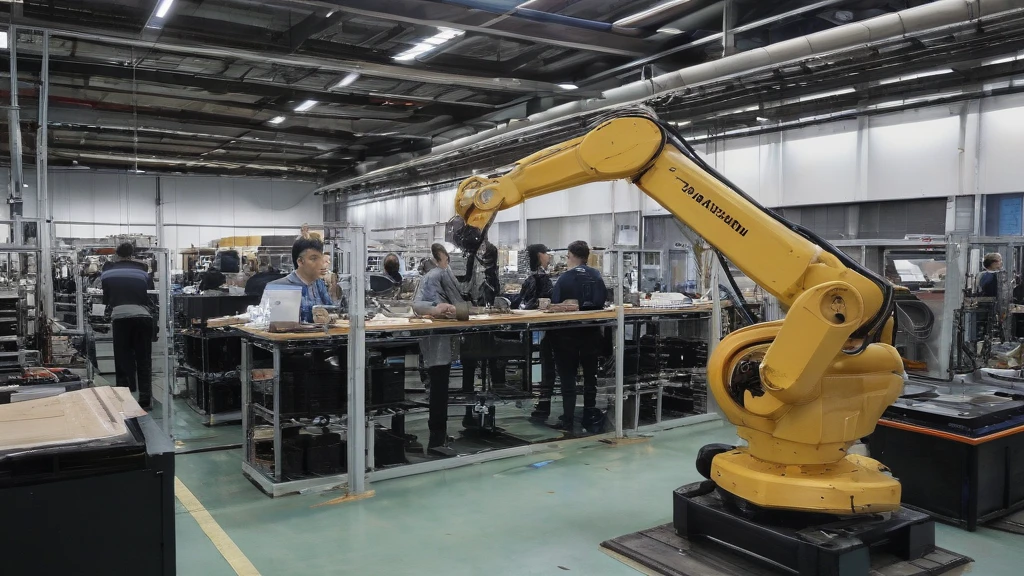
Robot density as a measure of industrial competitiveness
In 2019, the world average density of robots in industry reached a new record - 113 units per 10 thousand employees. This is not only a technological indicator but also a measure of national competitiveness. Robot density is the number of active industrial robots robots in relation to the number of employees - a method that allows comparing countries with different sizes of economies and employment structures. According to data from the International Federation of Robotics (IFR), the regions with the highest automation are Western Europe (225 units) and the Nordic countries (204 units). Among the countries, Singapore, South Korea and Japan are not only leaders but also major
robot manufacturers and users. Their industry is based on high precision, speed and scalability - features that automation can enhance. In the case of Singapore, 75% of all robots operate in the electronics industry, especially in the production of semiconductors and computer devices. This shows that automation is not an end in itself, but a tool to maintain an advantage in the most technological sectors.
South Korea and Japan - robot manufacturers and users
 Enlarged imageClose zoomPrevious image
In 2019, South Korea ranked second with a density of 868 robots per 10 thousand employees. This country is a leader in the production of LCD panels and DRAM memory, and its companies such as Samsung and LG are global giants. Automation in Korea is not limited to electronics - it is also a key element in the production of electric vehicles and batteries. Japan, third in terms of density (364 units), is also the largest robot manufacturer in the world - 47% of global production comes from this country. In Japan, robots not only produce other machines but are also an integral part of processes in the elect
rical (34%), automotive (32%) and metal (13%) industries. This shows a cycle: robot production supports their use, and use drives further innovation. In Germany - fourth place - the density was 346 units, and the automotive industry is one of the most automated sectors in the world. Surprisingly, at the same time, employment in the German automotive sector increased from 720 thousand to over 850 thousand people - which suggests that automation does not necessarily mean a reduction in jobs.
USA and the growing role of China in global automation
In the United States, robot density has increased to 228 units per 10,000 employees, indicating rapid progress in industrial automation. The USA is the second-largest automotive market in the world - after China - and its production of electric vehicles and components is highly automated. However, it is important to note that automation in the USA is not limited to a single sector. The increase in robot density shows that companies are investing in technologies that support flexibility and resilience to economic shocks. China - the largest market in the world - currently ranks 15th in terms of robot density, but its development is dynamic. The country also produces electric vehicles and batteries, as well as semiconductors and microprocessors - sectors that are key to the future of technology. Although robot density in China is lower than in Western countries, its investments in automation are growing rapidly. This means that global competition is no longer just about the number of robots, but about the quality of technology integration and the ability to adapt.
China not only produces electric vehicles and batteries, but also semiconductors and microprocessors - sectors that are key to the future of technology. Although robot density in China is lower than in Western countries, its investments in automation are growing rapidly. This means that global competition is no longer just about the number of robots, but about the quality of technology integration and the ability to adapt.
Automation is not only machines - it is a system transformation.
The 2019 results show that industrial automation is not only about the number of robots per employee. It is a transformation of the entire production system: from logistics and assembly to quality control and production management. In countries with the highest robot density - such as Singapore or South Korea - automation is part of an industrial strategy, and not just a tool for reducing costs. However, it is important to understand that high robot density does not automatically mean a reduction in employment. In Germany and the USA, there is an increase in the number of employees in the automotive sector despite growing automation - which suggests that robots support people, rather than replacing them. It is also important that automation requires new skills: engineers, programmers, system integration specialists. Therefore, technological development cannot be understood only as a replacement of humans by machines - it is rather a joint action of people and robots in new production models. The future of industry lies not in full automation, but in the intelligent combination of human creativity with machine precision.
Robot Race: The World´s Top 10 automated countries