
Leadership in shipments and transformations of the service robot market.
In 2025, global shipments of service robots exceeded 150,000 units, indicating an accelerating trend of mass implementation. According to IDC data, KEENON maintained its global leadership in this category - it was first in service robot shipments for consecutive years. This not only confirms its technological position but also shows that the market has moved from the experimentation phase to the commercialization phase.
In particular, market growth was most pronounced in the cleaning robot segment - their shipments increased by over 800% year-on-year. This is not just a number, but a signal that companies are beginning to invest in automating basic, repetitive tasks. In this context, KEENON's leadership is no coincidence - it is the result of a long-term strategy based on scalability and integration.
Humanoids in action: from coffee to store.
 Enlarged imageClose zoomPrevious image
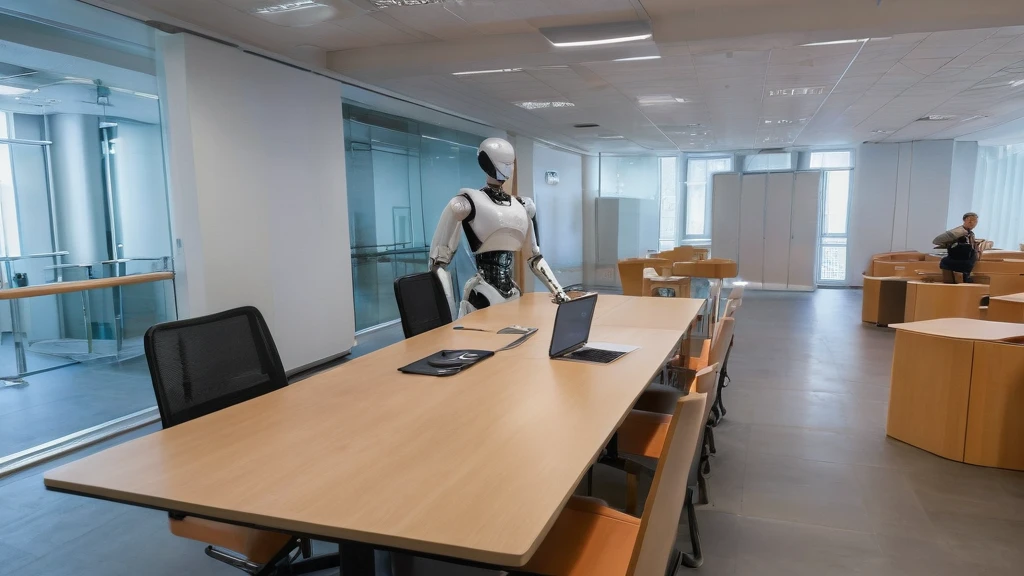
At the KEENON booth at WAIC 2026, a "service community with a body" was presented - four real-world scenarios in which XMAN-R1 humanoids performed tasks without teleoperation. In the coffee shop, the robot independently took cups, brewed coffee, and placed the drink on a latte art printing machine. In the hotel laundry, two humanoids collaborated: one loaded the laundry, and the other took it out and folded it.
In the dessert shop, the customer chose a color, and the robot identified, picked up, and delivered the appropriate M&M's. In the retail area, the robot recognized the shelf layout, searched for the product, picked it up, and handed it to the customer. Each of these operations was performed without human intervention in real time - this is not a technical demonstration but the first step towards full autonomy in public environments.
Sequence of actions: humanoids + specialized robots.
KEENON does not present humanoids as the only solution, but as part of a system. In the WAIC 2026 scenarios, humanoids were responsible for manipulation, interaction with people, and flexible tasks - such as selecting a product or preparing a drink. Specialized robots, such as DINERBOT T10 or KLEENBOT C40, performed high-frequency tasks: delivering food, cleaning floors.
This shows a real commercialization strategy: not everything has to be done by a humanoid. First, robots are introduced according to their role - people and machines work together in complete workflows. Only later, when the system stabilizes, is it expanded to general tasks. This approach reduces risk and allows for the gradual introduction of embodied intelligence into real-world environments.
What does this mean for the future of service robotics?
The scenarios shown at WAIC 2026 are not just a technical vision - they represent the first concrete step from demonstration to operation in real-world conditions. If humanoids can operate autonomously in a coffee shop, store, or hotel, it means that service robotics is moving beyond laboratories and exhibitions. It is no longer just about "what a robot can do," but rather "where it can work."
However, it should be remembered that these demonstrations took place in a controlled environment, without any unexpected events. In real-world conditions - for example, in a large store or hotel - additional testing, adaptation to changing conditions, and safety systems are needed. The transition from demonstrations to mass deployment requires many more steps, but KEENON has shown that the path is possible.
What was shown at WAIC 2026 has significance far exceeding individual demonstrations. The transition from autonomous operation of humanoids in controlled scenarios to their integration into real-world service environments represents a key breakthrough in the development of embodied robotics. The key to this success is not only advanced technology, but also KEENON's conscious approach to commercialization: instead of forcing humanoids onto all tasks, the company builds systems based on specialization. Humanoids handle what requires flexibility, interaction, and context recognition - for example, selecting a product by a customer or serving coffee with artistic latte printing.
At the same time, specialized robots, such as DINERBOT T10 or KLEENBOT C40, perform repetitive, high-frequency tasks - delivering food, cleaning floors - with higher efficiency and lower risk of errors. This approach allows for gradual scaling of deployments, reduces maintenance costs, and ensures greater system stability. In the future, this may lead to the creation of "digital employees" - robots that not only perform tasks but also learn over time and adapt to changing conditions.