Programming Kawasaki Robots in the AS Language
Advanced Control of Kawasaki Robots
Precise Automation in the AS Language
Process Optimization in Kawasaki Robots
Modern AS Control Solutions
Full Control over Industrial Robots
Efficiency and flexibility in programming
AS is an advanced programming language for Kawasaki robots that enables precise control and optimization of industrial processes. NexaRob provides support with configuration, integration, and adaptation of Kawasaki robots to specific production needs.
Contact us Watch the videoDiscover the Key Strengths and Capabilities of the Kawasaki AS Language, the Foundation of Precise Control for Kawasak Robots
Programming Kawasaki Industrial Robots in AS
Kawasaki AS is a dedicated programming language used in Kawasaki industrial robots, designed to provide high precision and flexibility in a wide range of production processes. The language combines relatively simple syntax with advanced functions that enable creation of complex motion sequences and control logic tailored to the specific needs of industrial plants.
With Kawasaki AS, programmers can create applications that enable:
- Precise Motion Control: Access to extensive motion commands such as linear, joint, and arc trajectories, enabling high-accuracy tasks to be performed.
- Easy Integration with Control Systems: Ability to connect seamlessly with other automation systems and peripheral devices such as sensors, cameras, or IoT systems.
- Process optimization: Automation of complex production operations, enabling rapid adaptation to changes in product range and flexible response to market needs.
Why Kawasaki AS?
- Clear and intuitive syntax: Makes learning and rapid implementation easier even for teams that are just beginning to program robots.
- Extensive configuration options: Enables precise definition of motion parameters, which is essential in applications requiring high accuracy.
- Versatility of Applications: This language performs well across many industries, from assembly to advanced welding processes, making it a versatile tool for companies with diverse production needs.
How Can NexaRob Help?
- Requirements Analysis and Consulting: Together with the client, we define goals and process specifics to select optimal hardware and software solutions.
- Code Creation and Optimization: We provide comprehensive support, from application development in Kawasaki AS and offline testing and simulation to deployment on the production line.
- Operator Training and Service Support: We provide comprehensive staff training so the team can independently make minor modifications and maintain the system at a high level of performance.
See what sets Kawasaki AS apart and in which applications Kawasaki robots achieve the highest efficiency
Key Functions and Application Examples in the Kawasaki AS Language
The Kawasaki AS language offers a range of advanced functions that facilitate the creation of applications controlling Kawasaki robots. They enable not only precise motion control but also dynamic adaptation to changing production conditions. Here are several key advantages of Kawasaki AS:
Modular Code Structure:
The program can be divided into modules containing definitions of procedures, variables, and motion configurations. This makes it much easier to keep the project organized and modify it in the future.
Application example: Large projects in which different production stations, such as a welding module, assembly module, and palletizing module, require separate procedures.
Extensive Motion Instructions:
Kawasaki AS enables precise definition of trajectories using commands for linear, joint, and arc movements. This allows robot motion to be adapted to specific production requirements while maintaining smoothness and precision.
Application example: Precision assembly, where point accuracy is important, and welding, which requires smooth transitions between points.
Network Communication Support
Kawasaki AS enables integration with external control systems such as PLCs or IoT systems. This allows robots to be synchronized with other production line elements and provides continuous process control.
Application example: Assembly lines where robots exchange data with a central production management system.
Safety functions
Built-in emergency procedures and monitoring mechanisms enable rapid response when irregularities are detected, such as excessive axis torque or unexpected displacement.
Application example: Lines where protecting operators and equipment is important, particularly in areas of human-robot collaboration.
Applications Across Different Industries
Kawasaki AS is used in industries such as automotive, food, metal, and electronics. Thanks to its flexibility, the language supports both simple and complex production operations.
Application example: Automation of assembly processes where fast and precise robot movements are essential to ensuring product quality.
Kawasaki AS Language provides advanced programming capabilities that allow the creation of flexible, precise, and safe applications for Kawasaki robots. NexaRob supports companies at every stage, from requirements analysis and code development to implementation and operator training, ensuring that your production line operates efficiently and in line with the latest automation standards.
Explore various ways to create code for Kawasaki robots and choose the solution best suited to your process
Tools and Best Practices: Programming Environment, Offline Editing and Debugging
Programming Kawasaki robots in AS can be done in several ways, from quickly creating code directly on the operator panel (Teach Pendant) to using an advanced simulation environment outside the production line. At NexaRob, we help select the right method for your facility requirements and team competencies so that writing and deploying code is fast, safe, and flexible. The main modes are outlined below:
Teach Pendant (Online Programming)
- Direct control: The operator can define the robot's trajectory point by point, saving sequences directly in Kawasaki AS code.
- Quick Corrections on the Line: Ideal when motion parameters or component positions need to be adjusted "on the fly" without shutting down the entire process for an extended period.
- Limitations: For more complex sequences, such as those involving a large number of points, greater care is required and configuration may take more time.
Offline Programming (Simulation Environment)
- Working on a computer: Kawasaki AS code and motion trajectories are created in a virtual environment, such as Kawasaki SimPro, before being transferred to the robot.
- Time savings: The line can continue operating while engineers prepare the next version of the code away from the production floor. After uploading it to the controller, only minor adjustments are usually required before work can continue.
- Application: Excellent for advanced applications where the risk of collision or complications is high and downtime is costly.
Remote Online Programming, Network-Based Control
- Remote access: If the network infrastructure is properly secured, the NexaRob team or your engineers can log in to the Kawasaki controller and modify code remotely.
- Expert support: Enables quick corrections in the event of sudden errors or unusual robot behavior without requiring physical presence at the machine.
Hybrid Approach
- Combining methods: Programmers often begin with the Teach Pendant for basic calibration and point setup, then move on to detailed optimization in an offline environment.
- Continuous improvement: After the initial configuration, the code can be progressively improved by testing different variants in a simulator and then applying final corrections online on the actual robot.
Methods programming in Kawasaki AS are flexible. Different approaches can be combined within one company depending on process complexity and the frequency of production changes. This enables rapid responses to emerging needs while saving time and costs. In the following sections, we will show how Kawasaki robots can work with vision systems and sensors to operate more intelligently and safely.
Learn how Kawasaki AS code enables robots to respond to camera and sensor data and adapt to changing conditions in the production process
Integration with Vision Systems and Sensors in Kawasaki AS
Kawasaki robots do not have to be limited to simply replaying programmed sequences. By integrating with devices such as cameras or force sensors, they can adapt to conditions on the line in real time. Below we explain how Kawasaki AS supports this flexibility:
Vision Systems
- Protocols and libraries: Kawasaki AS can use dedicated functions to communicate with 2D/3D cameras that provide information about the position, shape, or quality of parts.
- Dynamic Trajectory Correction: When objects are disorganized or position deviations occur, the robot automatically calculates motion offsets, increasing precision and shortening cycle time.
Force and Torque Sensors
- Pressure Control: In assembly applications or when handling delicate goods, the robot can respond to changing force, for example by slowing down or stopping movement to prevent damage.
- Collision Detection: If axis torque exceeds the permitted value, a Kawasaki AS program can immediately interrupt the operation and trigger a warning signal.
Integration with Infrastructure Control Systems
- Network communication: The robot can receive commands and transmit data to MES, ERP, or other PLC systems, working in synchronization with the entire production line.
- Additional Axis Control: Kawasaki AS enables control of additional axes, such as rotary tables and positioners, significantly expanding the robot's capabilities for machining or welding large components.
Application Examples
- Food industry: Sorting products of different sizes and shapes, where a camera provides position information and a force sensor allows delicate handling of sensitive packaging.
- Automotive: Welding unusually shaped sheet metal, with a camera verifying correct component positioning before and after welding.
- Electronics: Precise component assembly in which force-sensor readings protect delicate PCBs from damage.
The use of vision systems and force sensors enables robots to Kawasaki robots programmed in AS can adapt to changing production conditions by responding to deviations in component position or changing environmental parameters. NexaRob help select suitable devices, develop the code, and implement an integrated solution so your production line can achieve maximum efficiency and reliability.
See how Kawasaki AS code can improve key assembly stages in industrial applications
Case Study: Optimizing Assembly Processes with Kawasaki AS
In this section, we present a case study from the assembly sector where Kawasaki robots programmed in AS significantly improved efficiency and final product quality. Here are the key aspects of this implementation:
Context and Key Challenges
- Complex assembly processes: Many stages of assembling different subassemblies required meticulous precision and coordination.
- Low Tolerance for Errors: Even small deviations in component positioning could cause malfunction or require rework.
- Dynamic production: Frequent changes of product model or variant required rapid switching between motion sequences.
Modular Structure of Assembly Tasks
- Each key subprocess , for example tightening screws or fitting seals, had a separate module in the code.
- This made it easier to introduce changes, for example, when a new type of component to be installed appeared.
Integration with Force Sensors
- When a component needed to be inserted gently into a socket, the robot monitored the contact force.
- After excessive resistance is detected the code interrupted movement, warning the operator about a potential assembly error.
Results and Benefits
- Increased Assembly Speed: A single workstation with a Kawasaki robot replaced several manual stations, increasing productivity by approximately 25%.
- Reduction of mistakes: Dynamic force control and vision verification minimized the number of errors, resulting in fewer complaints.
- Easier adaptation to new models: Thanks to the modular logic of Kawasaki AS, engineers were able to easily introduce new assembly procedures without rebuilding the entire codebase.
The case study shows how flexibility of the Kawasaki AS language and integration with sensors and vision systems can significantly improve assembly processes. NexaRob supported the entire project, from needs analysis and code development to implementation and operator training, providing the company with a clear increase in production quality and efficiency.
Learn how to maintain high efficiency and reliability of Kawasaki AS applications while complying with required safety standards
Code Optimization and Safety Procedures in Kawasaki AS
After deploying an application in Kawasaki AS, it is worth ensuring continuous improvement. NexaRob recommends a set of practices that help maintain stability and performance while meeting stringent occupational health, safety, and quality standards:
Cycle Time and Motion Path Analysis
- Monitoring Statistics: The robot can report the number of cycles, downtime or number of errors. This data helps engineers identify opportunities for improvement more easily.
- Trajectory Optimization: Speed adjustments and reducing unnecessary travel can significantly accelerate the process while maintaining safety.
Code Structure and Readability
- Refactoring: Removing repetitive code fragments by creating modules and functions makes changes easier to implement and reduces the risk of errors.
- Consistent naming: Clear, consistent variable names such as nForceLimit and pHomePos support team collaboration and make debugging easier.
Safety Procedures
- Emergency conditions: Kawasaki AS code can stop robot movement at any time in the event of excessive load or a breach of the protected zone.
- Regular testing: We recommend periodically checking sensor operation, such as laser barriers and light curtains, and updating code to reflect new occupational health and safety regulations.
Updates and maintenance
- New firmware versions: Kawasaki may release controller software improvements. Assessing their usefulness and installing them when appropriate can improve robot stability.
- Application Expansion: If the production process changes or the scale of operations grows, you can easily expand AS code, for example by adding support for additional stations or axes.
Systematic optimization Kawasaki AS code and attention to safety procedures form the foundation for long-term robot operation. NexaRob provides support with inspections, motion-path optimization, and integration of new equipment so that your system maintains high efficiency and reliability throughout its entire service life.
Clear Up Your Questions About Creating and Maintaining Applications in Kawasaki AS and Learn About Our Support Model
Frequently Asked Questions
Below we answer frequently asked questions about programming Kawasaki robots in AS. If you do not find the answer you need, contact NexaRob. We will be happy to discuss your challenges and propose solutions tailored to your facility's needs.
Not necessarily. If someone understands control logic or has experience with other robot programming languages, learning Kawasaki AS is relatively straightforward. NexaRob offers training to help your team quickly become self-sufficient.
Kawasaki robots are popular in automotive applications such as welding and painting, electronics for precision assembly, the food industry for packaging and palletizing, and the metal industry for cutting and bending. The flexibility of the AS language makes it suitable for both simple and complex projects.
Yes. Dedicated environments such as Kawasaki SimPro are available for creating and testing code offline. This helps reduce production-line downtime and makes it possible to safely refine trajectories before the code is transferred to the actual robot.
Kawasaki AS provides libraries and protocols that allow the robot to receive data from cameras (2D/3D) and control positioners or rotary tables. In the code, motion can be dynamically adjusted based on information obtained from sensors.
As a rule, these are industrial robots that require fencing or appropriate safety systems. However, there are models with built-in collision functions, as well as the option to add vision or force systems that improve interaction safety.
It depends on the nature of production and the level of product assortment variability. Stable processes may require occasional adjustments, while dynamic lines that regularly add new products may need more frequent modifications and testing.
Yes. We work with a broad network of suppliers, including Kawasaki. We can help select the optimal robot model, configure AS hardware and software, and provide long-term service support.
Many code sections can be transferred and adapted to a new configuration by modifying reach, payload or speed parameters. NexaRob offers code-migration services between different Kawasaki robot models.
We invite you to contact us by email or phone. NexaRob will be happy to advise on equipment selection, develop Kawasaki AS code, and provide training in robot operation and daily maintenance.

Do you have more questions?
Contact NexaRob. Our specialists will help create and optimize solutions based on Kawasaki AS, tailored to the individual needs of your production. With comprehensive support and training, we help ensure that implemented robots operate efficiently and reliably while meeting all required safety standards.
Automate Your Business with NexaRob - Contact Us!
Interesting Facts from Around the World
How robots learn to improve in real time through critiques and residual flows.
A new approach to robotics, based on residual flow and level-of-detail criticism, has achieved a 66% success rate.
Teradyne Robotics and Sereact have implemented physical AI in Zalando’s logistics centers.
At Zalando’s logistics centers in Greven and Świebodzin, collaborative robots working with the Sereact Cortex platform operate automatically.
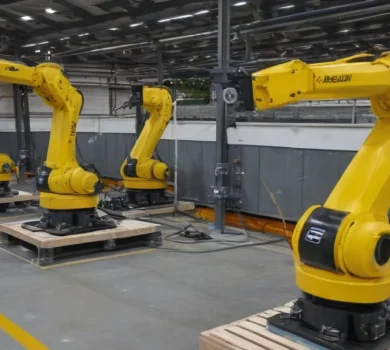
Full traceability in production thanks to robots and system integration
Atmus Filtration has implemented a modern robotic system for assembly and inspection, which ensures complete product traceability.
AGCO is testing a humanoid robot in production in Hesston, Kansas
AGCO and Agility Robotics will launch a pilot program featuring the Digit® humanoid robot at their manufacturing facility in Hesston.
How does the new diffusion model change the approach to autonomous driving?
The new QualiDrive model introduces an innovative approach to trajectory generation in autonomous vehicle guidance - instead of