
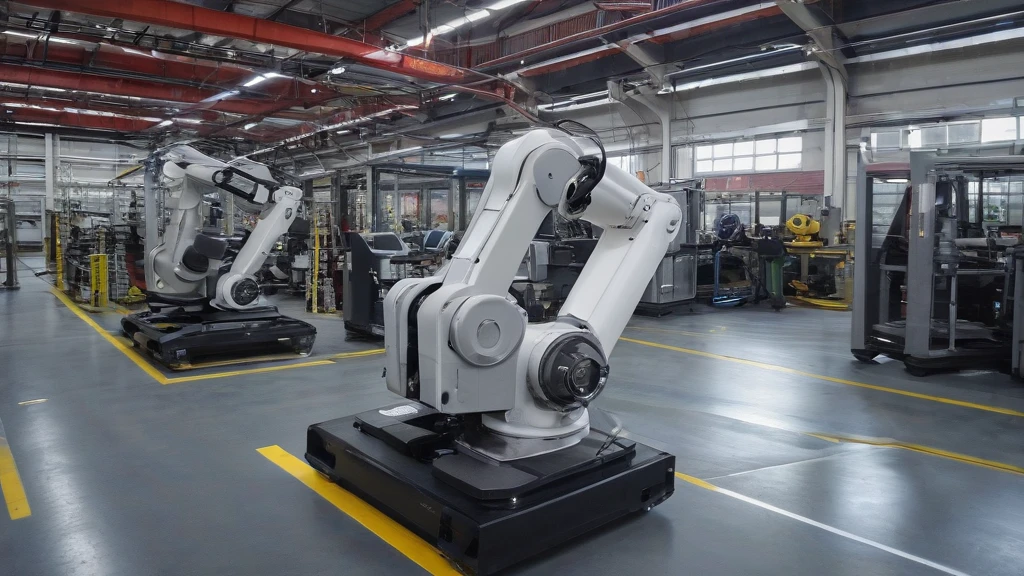
The new generation of robots is designed for physical AI.
Universal Robots presented the Gen 7 platform at the IMTS trade fair in September 2026. This is not just another update - it is a complete redesign from controller to teach pendant to tool mount. The new generation has been designed with the idea that. industrial robots they can operate in real time with AI models without additional external computers. The key to this is the new g-Series tool mount, which enables direct connection of cameras and high-bandwidth sensors, eliminating complex wiring and increasing system reliability.
The built-in force and torque sensor, supported by impedance control and RTDE (Real-Time Data Exchange), allows the robot to feel physical contact. This is key to dexterous manipulation applications - e.g., precise assembly of components in hard-to-reach places or gentle movement of glass parts. Thanks to this, the robot not only performs tasks but can also "learn" through interaction with the environment - which is the basis of physical AI.
New controller and software as a foundation for next-generation automation.
The central element of Gen 7 is the new CB7 controller, which offers 40% more computing power in a 30% smaller size than previous generations. This allows multiple communication networks to operate simultaneously - from PLC and HMI to MES, vision and IPC systems - without the need for additional switches. The controller is available both as a stand-alone box and in a compact version for mounting in a control cabinet.
The PolyScope X software is another key element of the platform. Integrated with open APIs and ROS2 support, it enables programming AI applications on the edge (edge-AI) without the need for an external computer. Integrators can use additional packages - e.g., ProfiSafe, OPC-UA or logic - as well as third-party software, such as Inbolt 3D Vision Guidance or Rocketfarm Pally. This is an open architecture that speeds up the deployment of new solutions.
Simplified programming and faster deployment.
The new TP7 teach pendant is over 20% lighter and more ergonomic than previous generations. It features multiple grip positions, configurable smart buttons, and a full HD touchscreen display. The new virtual joystick makes it easier to program even the most complex movements. All of this is designed to reduce learning time and increase operator efficiency.
In addition, the SP7 Smart Panel has been introduced - an interface for programming directly on the tool handle. Thanks to safety-compliant freedrive functionality, LEDs, and three configurable buttons, the operator can teach robots in their working environment. This is especially useful in high-mix production environments - such as small batches or rapid product changes. It reduces setup time and eliminates the need for dedicated programming stations.
Safety, certifications, and readiness for deployment
 Enlarged imageClose zoomPrevious image
Gen 7 not only supports new technologies - it is also ready for use in real industrial environments. All g-Series robots are certified by TÜV according to ISO 10218-1 and UL1740. The CB7 controller supports PLd, Category 3 safety functions (ISO 13849-1). Teradyne Robotics holds IEC 62443-4-1 ML3 certification for digital security - which means that security is built in at every stage of the software lifecycle.
The platform also supports the UR+ ecosystem, which identifies and tests partner products. All items in the portfolio are verified by both the partner and Universal Robots - which reduces integration risk and allows customers to deploy robots faster without lengthy testing.
What does this mean for industry?
Gen 7 is not just technology - it's a change in approach to automation. Thanks to its built-in readiness for physical AI, the robot can not only perform tasks but also learn them in real time. This opens up new possibilities in high-mix production, where rapid adaptation is key.
The introduction of new technical solutions - such as direct connection of sensors to the handle or edge AI integration - significantly reduces system complexity. This allows companies that are not robotics experts to quickly deploy new applications without having to first build complex IT infrastructures.
It is worth emphasizing, however: although Universal Robots declares readiness for physical AI and presents demonstrations with partners, there is no confirmed data on the actual deployment of these solutions in production. All of this is currently at the demonstration or pilot stage.