

Transform Robotics Humanoid Robot
TR1 - Intelligent Industrial Automation
Advanced technology from ULS Robotics
Precise manipulation and flexibility of movement
Versatile application across different industries
Safe Human-Robot Collaboration
Transform Robotics 1, The Future of Robotics
Transform Robotics 1, TR1, is a humanoid robot from ULS Robotics designed for precision process automation. Equipped with 27 degrees of freedom and advanced grippers, TR1 adapts to dynamic work environments. With exoskeleton and autonomous modes, it can be used in industry, logistics, and services.
Contact us Watch the videoTransform Robotics TR1 - ULS Robotics
Transform Robotics (TR1) Humanoid Robot
The Transform Robotics 1 (TR1) Humanoid Robot is a project by ULS Robotics focused on developing a new generation of transformational robotics. The key concept is the ability to transform the robot from an exoskeleton form (E mode) into an autonomous humanoid platform (H mode), increasing application versatility, from supporting personnel in exoskeleton mode to autonomously performing logistics or service tasks in humanoid mode.
According to manufacturer data, TR1 can reach a height of up to 190 cm, weigh approximately 120 kg, and offer 27 degrees of freedom (DOF). The robot has a payload capacity of up to 40 kg and computing power reaching 275 TPOS, indicating its ability to handle more demanding operations. A transformative element is the mechanism that allows the robot to switch between an exoskeleton form and a full humanoid form, supporting different work models depending on whether the robot is to cooperate with an operator or work independently in autonomous mode.
History and Development
TR1 Humanoid Robot
Tokyo Robotics has so far focused on solutions integrating collaborative robots in industrial and research sectors. In the Torobo project, the company decided to combine its experience in precision robotic manipulators with the ambition to create a bipedal platform developed particularly in artificial intelligence and motion learning.
From Robotic Manipulators to a Humanoid
- The company's earlier projects included stationary and mobile robots for industrial tasks and control systems with an emphasis on force control and collision detection. Torobo is a step forward toward more complex bipedal mechanics and activities resembling the human range of motion.
- With arm payload capacity, an innovative head design with optional sensors and depth camera, and an omnidirectional mobile base, the robot can serve both as an assistant in logistics processes and as an R&D platform for testing motion control algorithms in demanding environments.
Integration with AI Systems and Learning by Demonstration
- The manufacturer places strong emphasis on learning-by-demonstration technology and force-control methods such as impedance control and collision detection. This enables the robot to interact gently in environments where human safety is a priority.
- Thanks to ROS support, Torobo can use various software packages responsible for motion planning (MoveIt), visualization (RViZ), or simulation (such as MuJoCo). The robot's design and software enable rapid testing of reinforcement learning strategies or computer vision algorithms, also supported by an additional computer with an RTX 4070 graphics card if the customer requires it.
Technical Specifications
Technical Specification of the Transform Robotics TR1 Humanoid Robot
Transform Robotics 1 (TR1), developed by ULS Robotics, is based on the concept of combining an exoskeleton form, E mode, with a fully autonomous humanoid mode, H mode. This allows the platform to perform a variety of functions, from supporting an operator during physical work to independently carrying out tasks in environments designed for people. The key technical parameters of TR1 are presented below:
| Parameter | Value | Notes |
|---|---|---|
| Height (robot in humanoid form) | 190 cm | Enables operation at a height similar to a human. |
| Number of degrees of freedom (DOF) | 27 | High joint mobility, enabling many complex movements. |
| Force sensors (six axes) | 4 ~ 8 | Support precise force and torque control in key joints. |
| Weight (total mass) | 120 kg | Enables stable movement and handling of payloads up to 40 kg. |
| End payload | 40 kg | Designed for tasks requiring lifting medium-weight loads in service or warehouse environments. |
| Battery operating time | 2 hours | Sufficient for medium-duration operational tasks; charging between tasks is possible. |
| Computing power | 275 TPOS | Supports AI algorithms and real-time processing of large data sets. |
| Dual Mode | - Exoskeleton (E mode) - Humanoid (H mode) |
The robot can operate as an assistive exoskeleton or an autonomous humanoid, depending on task requirements. |
Flexible Movement Mechanisms
- Al Learning Exoskeleton: In E mode, the robot functions as a "skeleton" supporting the operator, assisting human muscles in tasks requiring greater strength or precision.
- Autonomous humanoid operation: In H mode, the robot switches to autonomous operation, using built-in computing power (275 TPOS) and 27 DoF, enabling it to move in conditions requiring mobility and object manipulation.
Innovative Design
- Three-finger claw: A proprietary, robust three-finger gripper supported by force control and obstacle detection systems. This solution allows TR1 to operate in environments requiring precision and durability.
- Super power system: A body with extensive transformation potential, combining humanoid and exoskeleton functions. This enables adaptation to different work scenarios, from supporting a person in manual tasks to independent operation.
TR1
Applications and Use Cases
Thanks to its dual-mode concept, exoskeleton / humanoid, Transform Robotics 1 (TR1) can be used across a wide range of industries and situations. From human assistance in E mode to full autonomy in H mode, the robot offers versatility rarely found in traditional solutions.
Support for Physical Work (E Mode - Exoskeleton)
Assisted Lifting and Raising: In exoskeleton form, TR1 can help workers carry heavier loads, reducing fatigue and the risk of injury.
Logistics and Warehousing Sector: The robot acts as "body assistance," reducing physical effort in tasks such as order picking or placing products on shelves.
Autonomous Humanoid Tasks (H Mode, Autonomous Operation)
Light Industrial Applications: The robot moves in environments designed for people and can manipulate objects weighing up to 40 kg at the end of the arm, which can support assembly tasks or component transport.
Service and Marketing Sectors: Bipedal mobility and a humanoid silhouette attract attention at events and service points. This form of interaction provides an additional attraction and supports promotional activities.
Education and Research Sector
R&D Work: Integration with AI and machine learning systems makes TR1 a platform for testing new control, pattern recognition, and motion planning algorithms in conditions close to real environments.
Robotics Laboratories: Students and researchers can use the robot's multimodal nature, combining E and H modes, to study human-robot interaction, movement biomechanics, or advanced forms of collaboration.
Healthcare and Rehabilitation Environment
Patient Assistance Mode: A robot in exoskeleton form supports motor rehabilitation or assists people with limited strength in moving.
Autonomous Mode: In areas requiring the transport of lightweight medical materials or staff assistance, the robot can independently travel through corridors, delivering small items of equipment such as bandages or medicines.
Home Assistance and Care
Support for Everyday Tasks: In a home environment, the robot can switch from exoskeleton mode to an autonomous form, helping move objects or assisting the user with everyday activities.
Future Development Directions: Thanks to learning functions, including large-model training and adaptive algorithms, TR1 can develop its ability to adapt to increasingly diverse needs and situations in a home environment.
Transform Robotics 1 therefore represents a vision of future robotics in which a single platform can serve both as an assistive exoskeleton and as a humanoid robot for autonomous tasks. In this way ULS Robotics introduces an innovative concept to the industry, focused on flexible use of the robot in different modes and environments.
Technology and Innovation, Safety
Transform Robotics 1
The Transform Robotics 1 (TR1) robot from ULS Robotics brings a distinctive approach to humanoid robotics through its unique concept of converting from an exoskeleton (E mode) into a fully autonomous humanoid mode (H mode). This approach allows the robot to be flexibly adapted to specific requirements, from supporting an operator during heavier work to independently carrying out logistics or service tasks.
Conversion of an Exoskeleton into a Humanoid
- Dual Operating Mode: The transformation mechanism allows TR1 to function both as an external support frame for a person and as an autonomous humanoid robot capable of independent locomotion and object manipulation.
- Foldable Design: The robot features a carefully designed structure that enables transition from exoskeleton mode to humanoid mode while maintaining stability and safety.
Speed and Precision of Movement
- 27 Degrees of Freedom (DOF): This number of motion axes supports smooth robot locomotion and precise execution of tasks requiring complex motion sequences, such as carrying objects through narrow corridors or descending stairs in humanoid mode.
- 275 TPOS Computing Power: High computing performance enables the robot to process large datasets in real time, for example for environment analysis or advanced motion control algorithms.
Safety and Force Control
- Six-Axis Mechanical Sensors (4-8): They enable the robot to detect overloads and collisions precisely, improving protection for personnel and the surrounding environment.
- Three-Finger Claw System: The robot's proprietary gripper is equipped with force control and obstacle-detection functions, helping prevent accidental crushing or damage to delicate objects.
Exoskeleton AI Learning (E mode)
- Operator Support: A robot in exoskeleton form allows a person to use assisted force during physical processes, increasing efficiency with less effort and a lower risk of injury.
- Applications in Rehabilitation and Care: The ability to adapt to individual user parameters supports the use of TR1 in medical facilities, rehabilitation projects and assistance for people with limited mobility.
TR1 Robot
Integration and Compatibility, Personalization and Solution Customization
ULS Robotics designed TR1 for a broad range of scenarios in which the robot can cooperate with people or operate autonomously. Key aspects include modularity, open software architecture and options for adapting robot functions to current business or educational needs.
Modular Design and "Garments"
- Replaceable Structural Components: Designed so that components can be easily added or replaced, such as different gripper variants or additional sensors supporting navigation.
- Optional Robot "Clothing": The manufacturer provides the option to customize the external appearance, for example the color or panels bearing the customer's logo, which is important for branding and promotional purposes.
Adaptation to Tasks and IT Systems
- ERP / WMS Integration: The robot can be connected to management systems, for example in warehouses, automatically receiving transport orders while operating in humanoid mode.
- Software Customization Capabilities: TR1 supports various development environments and AI libraries, making it easier to create dedicated applications such as speech recognition or task planning based on rules defined in the cloud.
Support for Learning Algorithms
- Use of AI Models: Computing power of 275 TOPS enables the integration of reinforcement learning or learning-by-demonstration algorithms, especially in autonomous humanoid mode (H).
- Training on Large Datasets: The robot is designed for training large models, expanding its potential functions from situation recognition to adaptation to complex environmental conditions.
Potential for Human Collaboration
- Exoskeleton Mode: TR1 can function as an external assistance system, helping operators with tasks requiring greater strength and endurance, reducing fatigue and improving workplace safety.
- Autonomous Mode: The robot can perform specific activities without constant supervision, for example when moving goods in a warehouse, working on a packaging line or assisting at a customer service point
Thanks to these properties TR1 represents a platform that can be easily adapted to different environments, from industrial halls where efficiency and safety are important, through service companies, to research and development centers focused on creating innovative control and learning algorithms. The ability to switch smoothly between humanoid and exoskeleton modes distinguishes ETH-01 as a solution focused on flexibility and versatile applications.
Transform Robotic Humanoid Robot
Benefits for Customers
The Transform Robotics 1 (TR1) Humanoid Robot by ULS Robotics is an innovative combination of an exoskeleton and an independent humanoid. This design enables efficient adaptation to service, industrial and educational environments where both bipedal mobility and support for people performing demanding physical tasks are important. Companies and institutions can therefore gain a versatile platform that increases efficiency, reduces operating costs and broadens the scope of automation.
Versatility and Application Flexibility
- Exoskeleton Mode (E): TR1 can serve as an external “skeleton” supporting human movement, improving productivity while reducing strain on the musculoskeletal system.
- Humanoid Mode (H): The robot gains autonomous locomotion and the ability to perform light logistics or service tasks, reducing staff workload in places where a human operator is not essential.
Performance with Moderate Investment
- Payload up to 40 kg: The ability to carry loads of this weight allows TR1 to be used in many processes related to goods distribution or everyday manual tasks.
- 2-Hour Battery Operation: Sufficient for a range of short and medium-length operational tasks. If necessary, the robot can be recharged during breaks or use optional solutions that support continuous operation.
Improved Safety and Comfort
- Exoskeleton Mode: Reduces the risk of strain and injury in lifting tasks, supporting personnel in physically demanding or repetitive activities.
- Six-Axis Force Sensors: They give the robot precise control of torque and force, enabling safe work near people and effective accident prevention.
Development Opportunities and Integration with AI
- Training with Large Models: The robot is designed to work with AI algorithms, including machine learning methods that can increase its adaptability and range of tasks.
- Future-Oriented Platform: Bipedal robot forms have the potential to replace or support people in environments designed for humans, including stairs and narrow passages. TR1 follows this trend, offering the prospect of continuous improvement and expansion of its functions.
FAQ - Frequently Asked Questions
Transform TR1 Humanoid Robot
Below are answers to the most frequently asked questions about TR1. If you have additional questions, we recommend contacting the manufacturer or NexaRob, which supports the integration and implementation of robotic solutions.
ULS Robotics offers Transform Robotics 1 primarily through pilot projects or dedicated orders. Availability and configuration depend on specific customer requirements.
The price depends on the version (sensor range, computing power, additional modules), technical support, and integration with IT systems. Once requirements have been defined, a turnkey quotation can be presented.
Although TR1 is not strictly limited to indoor use, it performs best indoors or in controlled environments. Outdoor operation and adverse weather conditions are not its primary target area.
In E mode, the robot assists human movement, so training is provided in safe use and configuration. The manufacturer and integration companies usually offer instruction.
TR1 can operate for up to 2 hours on battery power during standard activities. Charging time and top-up rules depend on the selected power-supply method.
Detailed information has not been disclosed. Humanoid robots of this type generally move cautiously, adapting their steps to stability and terrain. However, gradual increases in speed may be possible as the algorithms are improved.
The manufacturer emphasizes integration with machine learning (large models), suggesting that TR1 can be extended with cloud-based data analysis services and AI algorithms added by partners or integrators.
The basic dimensions, a height of 190 cm and a weight of 120 kg, refer to the humanoid form. In exoskeleton mode, the robot may have different joint spacing and lengths, although detailed parameters should be confirmed with the manufacturer.
According to information from ULS Robotics, the robot can support people with limited mobility in the form of an exoskeleton. To implement it in medical processes, however, local regulations must be taken into account and appropriate safety tests must be carried out.

More questions?
If you would like to learn more about humanoid robots, we invite you to browse our complete FAQ section. There you will find additional questions, detailed instructions, and useful tips.
Why NexaRob?
Your Trusted Partner in Humanoid Robotics - Knowledge, Passion, and Innovation
NexaRob supports companies and institutions in effectively using humanoids such as Transform Robotics 1 (TR1) from ULS Robotics. Our mission is to connect innovative technologies with specific business, scientific, or educational needs so that the robot delivers real benefits in everyday operations, from light logistics tasks through presentations and events to research projects.
- Expertise in Humanoid Robotics Through cooperation with a global network of suppliers, NexaRob provides access to modern and proven solutions. We analyze the conditions in which the humanoid is expected to operate and then select appropriate functions and modules, such as force sensors or a computing system, supporting optimal use of TR1 across different applications.
- Individual Approach to Projects Every implementation begins with a discussion and an assessment of the organization's needs. For TR1, we consider whether the priority is exoskeleton mode, physically supporting the operator, or an autonomous humanoid form. We create an implementation plan covering equipment configuration, integration with existing IT infrastructure, and the possibility of extending the solution with cloud AI services.
- Implementation Support and Service NexaRob does not limit itself to supplying the robot. We offer installation services, team training, and long-term service. We assist with motion programming, gripper adaptation, and integration with management systems such as WMS and ERP. Our goal is for a humanoid robot to be a useful tool rather than merely a technological curiosity.
- Innovation and Further Development We are active in R&D, which enables us to implement increasingly advanced solutions. We propose expanding TR1 capabilities with machine learning algorithms, force control, and additional vision and tactile sensors. In this way, the humanoid can
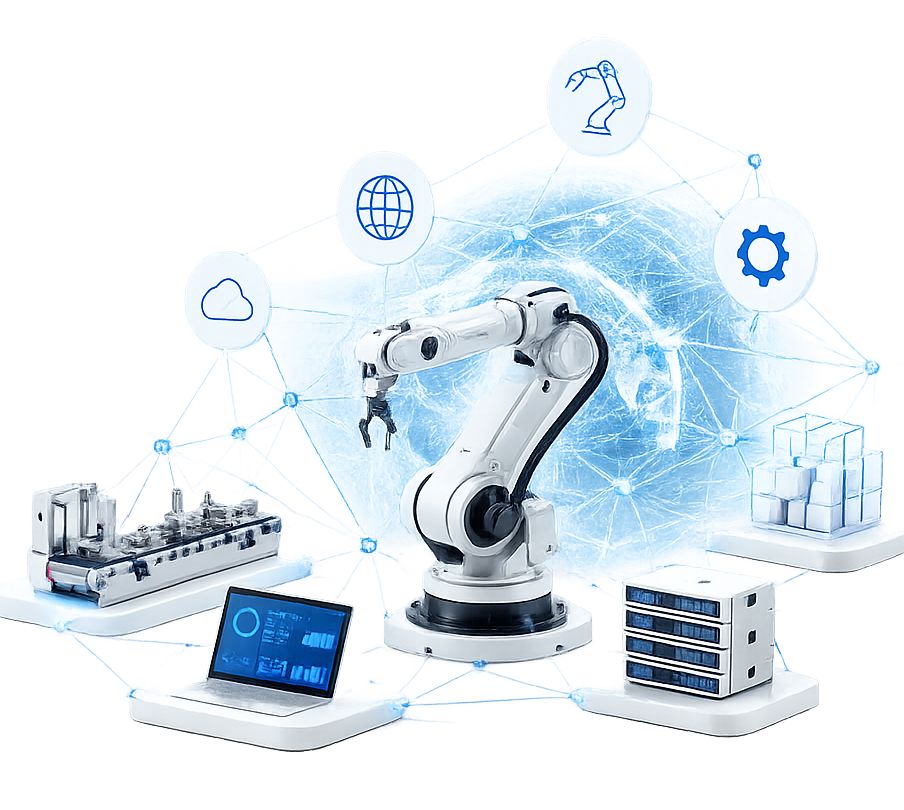
If you want to deploy Transform Robotics 1 (TR1) in your company, research facility, or even as part of a marketing presentation, NexaRob will be happy to assist you throughout the process. We will provide consulting on option selection and robot configuration, as well as training that enables effective day-to-day use of the humanoid. Contact Us - Choose Innovation!
Automate Your Business with NexaRob - Contact Us!
Join NexaRob and Let Us Develop Humanoid Robotics Together
Would you like to become our Partner?
NexaRob is looking for suppliers, manufacturers, and companies interested in implementing innovative automation technologies. We believe that by combining a passion for modern solutions with cooperation across a global network of partners, we can introduce humanoids such as TR1 in various sectors of the economy, from logistics and services to education.

United States

China

Japan

Germany

India

United Kingdom

France

Italy

Canada

South Korea

Brazil

Australia

Spain

Mexico

Indonesia

Netherlands

Saudi Arabia

Turkey

Switzerland

Taiwan

Poland

Sweden

Belgium

Thailand

Ireland

Austria

Norway

Israel

United Arab Emirates

Argentina

South Africa

Denmark

Philippines

Singapore

Malaysia

Colombia

Bangladesh

Egypt

Chile

Finland

Vietnam

Portugal

Czech Republic

Romania

New Zealand

Peru

Greece

Ukraine

Slovakia

Hungary

Slovenia

Croatia

Serbia

Bulgaria

Estonia

Latvia

Lithuania

Iceland

Luxembourg

Malta

Cyprus

Morocco

Algeria

Tunisia

Nigeria

Kenya

Ethiopia

Ghana

Tanzania

Uganda

Angola

Senegal

Qatar

Kuwait

Oman

Pakistan

Sri Lanka

Nepal

Kazakhstan

Uzbekistan

Mongolia

Russia

Cambodia

Myanmar

Laos

Fiji

Papua New Guinea

Venezuela

Ecuador

Uruguay

Paraguay

Bolivia

Costa Rica

Panama

Dominican Republic

Guatemala

Cuba

Jordan

Lebanon

Iran
Additional countries in Europe
These countries are hidden in reader mode so that the map is not overcrowded. Click a country to open contact details, email and a description of the cooperation area.
Additional Countries in Asia
These countries are hidden in reader mode so that the map is not overcrowded. Click a country to open contact details, email and a description of the cooperation area.
Additional Countries in the Americas
These countries are hidden in reader mode so that the map is not overcrowded. Click a country to open contact details, email and a description of the cooperation area.
Additional Countries in Africa
These countries are hidden in reader mode so that the map is not overcrowded. Click a country to open contact details, email and a description of the cooperation area.
Additional Countries in Oceania
These countries are hidden in reader mode so that the map is not overcrowded. Click a country to open contact details, email and a description of the cooperation area.
Albania
Andorra
Belarus
Bosnia and Herzegovina
Montenegro
Liechtenstein
North Macedonia
Monaco
Moldova
San Marino
Afghanistan
Armenia
Azerbaijan
Bahrain
Bhutan
Brunei
Georgia
Iraq
Yemen
Kyrgyzstan
North Korea
Maldives
Syria
Tajikistan
Timor-Leste
Turkmenistan
Antigua and Barbuda
Bahamas
Barbados
Belize
Dominica
Grenada
Guyana
Haiti
Honduras
Jamaica
Nicaragua
Saint Kitts and Nevis
Saint Lucia
Saint Vincent and the Grenadines
El Salvador
Suriname
Trinidad and Tobago
Benin
Botswana
Burkina Faso
Burundi
Cabo Verde
Chad
Democratic Republic of the Congo
Djibouti
Eritrea
Eswatini
Gabon
Gambia
Guinea
Guinea-Bissau
Equatorial Guinea
Cameroon
Chambers
Congo
Lesotho
Liberia
Libya
Madagascar
Malawi
Mali
Mauritania
Mauritius
Mozambique
Namibia
Niger
Central African Republic
Rwanda
Seychelles
Sierra Leone
Somalia
Sudan
South Sudan
Togo
Ivory Coast
São Tomé and Príncipe
Zambia
Zimbabwe
Kiribati
Micronesia
Nauru
Palau
Samoa
Tonga
Tuvalu
Vanuatu
Marshall Islands
Solomon Islands
Why Cooperate with NexaRob?
Joint Investments in Innovation
We prepare turnkey projects, combining humanoid robot deliveries with integration services so that companies can not only use robotics but also develop it as their needs grow.
Synergy of Competencies
At NexaRob, we bring together engineers, AI specialists, and IT implementation experts, enabling us to design and deliver comprehensive humanoid robotics solutions.
Global Reach
We operate internationally, adapting humanoids to local regulations and requirements. We help scale projects into new markets and provide service support at a global level.
We Are Looking for Partners in the Following Areas:
- Production and Distribution of Humanoid Robots We work with companies that want to offer their platforms, such as TR1, to a wider audience, with support in integration and implementation.
- AI and IoT Technologies We connect humanoids with cloud services and machine learning algorithms, increasing their autonomy and making real-time interaction with users easier.
- Automation and Logistics Systems Humanoid robots can operate where stationary or wheeled solutions face limitations, offering mobility and the ability to adapt to spaces designed for people.
Let's Join Forces
If you are considering implementing Transform Robotics 1 or another humanoid robot in your organization, NexaRob is ready to help. Together, we will plan and carry out the implementation, tailoring every element from hardware and software to training and service. With us, humanoids can become not only an effective tool, but also a symbol of innovation and progress in your workplace. Contact NexaRob and let us begin working together to advance humanoid robotics!
Interesting Facts from Around the World

IRIM 2026 Seminar: How can robotics achieve seamless physical interaction with humans?
On October 21, 2026, the Institute for Robotics and Intelligent Machines will host a lecture.
DriveWorld3D: a new generative simulation for safe autonomous driving
The new DriveWorld3D system, developed by the Robostreet team in Cambridge, is designed to help create safer models
Microlocalization: precise positioning of mobile robots based on microscopic textures of the substrate.
Researchers have presented a new method for localizing mobile robots with an accuracy of tens of micrometers, using microscopic textures
Robotics as a space for creativity and diversity: experiences of researchers from the Oxford Robotics Institute
As part of the International Women in Engineering Day 2026, researchers from the Oxford Robotics Institute (ORI) shared
How does a solar-powered autonomous vessel decide on the most important places to investigate?
Researchers from academic institutions and other organizations have developed a new method for mission planning for autonomous ships