
Programming FANUC Robots in Karel
Advanced FANUC Robot Control
Precision Process Automation
Optimization of FANUC Robots in Karel
Modern control algorithms
Flexible solutions for industry
Maximum System Control and Performance
The Karel language enables advanced control of FANUC robots, providing maximum programming precision and flexibility. NexaRob offers comprehensive support in configuring, optimizing, and integrating FANUC systems, adapting them to individual production requirements.
Contact us Watch the videoLearn why Karel has become the foundation of many advanced implementations in industrial automation
Programming FANUC Industrial Robots in Karel
FANUC Karel is a dedicated programming language used in FANUC industrial robots. Its structure, similar to traditional procedural languages such as Pascal, makes it possible to create complex motion sequences and control logic. In practice, this means the code can handle advanced operations, from precision assembly and welding to intelligent object sorting based on camera images.
Why FANUC Karel?
- Close similarity to Pascal: Creating variables, loops, and conditional blocks is straightforward, which accelerates learning to program and makes code maintenance easier.
- Extensive libraries: Handling input/output signals, communication with external devices (e.g. PLC controllers) and extensive procedures for motion management.
- Flexibility: Easy adaptation of robot trajectories to new products or operating modes, as well as the ability to work with vision systems and force sensors.
How Can NexaRob Help?
- Integration with a Global Supplier Network: We offer not only experience in writing Karel code, but also in selecting components such as cameras and grippers for complete solutions.
- Creating new applications: From process analysis through code implementation and offline testing, including in Roboguide, to final deployment in your factory.
- Migrations and optimizations: We audit existing applications, removing unnecessary travel and adding safety procedures so the line can operate more steadily and efficiently.
Discover the Key Advantages of Karel and Learn Which Processes Make FANUC Robots Especially Effective
Key Functions and Application Areas of FANUC Karel
Although every robot programming language has its advantages, FANUC Karel stands out for a set of features that gives programmers considerable freedom when building tasks. Below are several areas where Karel and FANUC robots can deliver the greatest benefits:
Precise trajectory control
The robot can move along multi-point paths, such as arcs and lines, and dynamically adjust movement speeds based on sensor data.
Application: Welding or assembly processes where weld uniformity or avoidance of damage to delicate parts is important.
Multitasking and Parallel Operation
Description: Karel can run several threads, or tasks, simultaneously, for example to handle an HMI interface, monitor safety signals, or communicate with vision systems.
Application: Larger production lines where one robot must respond quickly to many inputs (e.g. signals from sensors and an operator).
Network Communication Support
Description: Standard libraries are available for exchanging data with external devices such as PLCs, databases and IoT systems.
Application: Warehouses with order-picking robots, automotive industry applications with robots working alongside CNC machines.
Advanced safety procedures
Built-in functions for detecting emergency conditions and immediately stopping robot motion, for example in the event of a collision or unauthorized entry into the work zone.
Application: Installations where operator protection is the priority, such as lines involving high temperatures or heavy components.
Flexible I/O Libraries
Easy control of outputs, such as opening a gripper, and reading inputs, such as a part-presence sensor, which is useful in most production applications.
Application: Sorting and palletizing, assembly with component-position control, logistics transfer stations.
FANUC Karel offers efficient yet understandable tools for programming robots across many industrial sectors. From handling applications, through welding, to advanced quality control, robots FANUC, thanks to the flexibility of the Karel language, can adapt to the specific requirements of a facility. NexaRob helps fully utilize these capabilities by combining world-class technology with practical integration experience.
Discover a set of programs and recommended practices that make FANUC KAREL coding easier and more efficient
How to Get Started with KAREL
Tools and Best Practices
Getting started with KAREL can be easier than it initially seems, especially when you use the right tools and proven coding methods. Below are the main steps and best practices that can help you quickly create stable and efficient programs for FANUC robots.
Roboguide Installation and Configuration
- Official FANUC tool: Roboguide is an offline environment where you can create and test KAREL code without stopping actual production.
- Simulation Projects: Create a new project, import the robot model, and initially define the workstation layout. This allows you to verify motion trajectories and avoid physical collisions during later commissioning on real hardware.
Code Structure and Modularity
- Files and procedures: Applications should be divided into logical modules, such as procedures and functions, making organization and code reuse easier.
- Comments and naming: Use descriptive variable names, such as pPick, pDrop, and nSpeed, and leave clear comments. This makes it easier to navigate the code, especially in larger projects.
Offline and Online Editing
- Offline Mode: Writing and testing code in Roboguide before transferring it to the physical robot. This helps reduce production line downtime.
- Online corrections: If necessary, you can make minor code changes directly at the actual workstation, for example by adapting motion parameters to production conditions.
Debugging and Log Handling
- Diagnostic messages: Adding displays of key information about variables and program status significantly speeds up problem detection.
- Version repository: Storing code in a version control system (e.g. Git) makes it easier to compare changes and revert to previous versions when needed.
Best Practices
- Clear Architecture: Dividing tasks in KAREL into smaller, easy-to-maintain functions.
- Consistent coding style: Establish naming and formatting conventions, such as spacing and comments, so that the entire team can easily understand the project.
- Pre-deployment tests: Always test code in a simulator first, reducing the risk of errors on the production line.
A good start with FANUC KAREL begins with learning the tools, including Roboguide) and consistent application of practices that enable clear code to be written. NexaRob provides support from implementing the programming environment and training to final application optimization on real robots FANUC. This allows you to expand automation in your facility with guaranteed reliability and safety.
See how KAREL code enables FANUC robots to respond to data from cameras and sensors to meet the challenges of modern production
Integration with Vision Systems and Additional Sensors
FANUC robots using KAREL do not have to be limited to predefined routes. Through integration with vision systems and force sensors, they can dynamically adapt movements to current environmental data. As a result, the robot gains “senses” that allow it to operate more effectively and efficiently under changing conditions.
Communication with Cameras, Vision Systems
- Protocols and libraries: FANUC provides a set of functions for receiving object coordinates from 2D/3D cameras, allowing KAREL to dynamically correct the robot's trajectory.
- Vision-guided pick and place: Code can calculate motion offsets when a part is unexpectedly positioned on a conveyor, minimizing errors and shortening cycle time.
Force and Torque Sensors
- Pressure Control: In applications where delicate handling is required, such as assembling sensitive components, the robot can monitor contact force in real time and stop movement when the set value is reached.
- Adjustable parameters: Code in KAREL makes it possible to change the speed or movement angle based on values read from a sensor, helping prevent damage to components.
Digital and Analog Input/Output Handling
- Integrated control: The robot can simultaneously issue commands to other devices, such as activating a gripper, and receive machine readiness signals, ensuring synchronization of the entire process.
- Analog Data: Voltage or current values can be read, which is useful in advanced processes (e.g. liquid dosing, temperature control).
Emergency and Safety Procedures
- Response to Alarm Signals: When a camera or force sensor detects an abnormality (e.g. a displaced part or excessive pressure), KAREL code can immediately stop movement and display a warning message.
- Example industries: Automotive (welding and geometry inspection), food industry (gentle product handling), electronics (assembly of small PCB components).
Example Applications
- If the robot needs to pick parts of different sizes, a 2D camera identifies the component type and sends the data to the KAREL program. The robot automatically selects the appropriate route and gripping force for the specific part.
Thanks to integration with vision systems and force sensors, robots FANUC with code KAREL can operate in a much more flexible and autonomous way. NexaRob ensures the development of a complete application, from equipment and communication library selection to implementation of the logic in KAREL. As a result, your production line gains efficiency and precision while maintaining full operational safety.
A practical example showing how the Karel language can increase the precision and efficiency of a welding process
Welding Automation in the Metal Industry
To illustrate the potential and flexibility of Karel code, we present a case study from the metal industry, where the key challenge was automating the welding process for components of varying shapes and dimensions.
Project Objective
- Faster and more repeatable welding of metal products while reducing errors.
- Adaptation to a changing product range, the robot had to handle both small, lightweight parts and larger structures.
Challenges
- Maintaining welding arc stability: The robot must precisely maintain parameters such as position, speed, and current.
- Variety of shapes: The need to detect edges and determine the welding trajectory according to product dimensions.
- Ensuring safety around the welding area where sparks and high temperatures occur.
Key solutions in Karel code
- Advanced motion functions: The use of control loops enabled dynamic correction of speed and torch angle during operation.
- Integration with a vision system: A camera monitoring part edges sent coordinates to the program, while Karel corrected the welding path in real time.
- Safety procedures: calling motion stop instructions when sensors indicate that permitted parameters have been exceeded, for example temperature limits or the movement of nearby people.
Final Results
- Reduction of welding defects by approximately 30% compared with the previous semi-automatic process.
- Reduced cycle time, in automatic mode the robot handled up to 25% more parts per day.
- Flexibility: when the product changed, engineers made only minor modifications to the code module, significantly accelerating introduction of new series.
This case demonstrates that Karel code is well suited to complex welding processes where both high accuracy and adaptability are required. NexaRob supported the customer at every stage, from defining requirements and writing and testing code to implementation and training, providing a stable and efficient robotic welding system FANUC.
How to Maintain the Performance and Reliability of Karel Applications While Meeting High Safety Standards
FANUC Robot Code Optimization and Safety
No code lasts forever. As production processes develop or product ranges change, ABB RAPID applications may require optimization and updates. NexaRob offers code debugging and refactoring services to increase robot efficiency and respond quickly to emerging challenges.
Cycle Time and Motion Analysis
- Recording points: Adding logs and statistics, such as the number of movements or total axis travel distance, makes it possible to identify unnecessary motions.
- Speed and acceleration parameters: After the testing phase, it often becomes apparent that the robot can accelerate certain movements without increasing collision risk, reducing overall task execution time.
Code Structure and Readability
- Removing repetitions: Allows repetitive sequences to be converted into procedures called from different parts of the program, simplifying modifications and debugging.
- Consistent naming: It makes the program easier for the entire team to understand and, when the system is expanded, speeds up the introduction of additional functions.
Safety Procedures
- E-stop and safe zone signaling: Properly written Karel code can continuously monitor signals from emergency buttons and sensors around the work area, activating a motion stop when necessary.
- Collision Interlocks: In projects where two FANUC robots work next to each other, it is worth adding mechanisms that prevent the robots from entering each other's collision trajectories.
Software updates
- New firmware versions: FANUC occasionally releases updates and new functions that can be installed in the robot controller. NexaRob helps assess the benefits and carry out updates safely.
- Project Scalability: When a second robot or additional devices are added to the line, we extend the code to support additional modules and communication protocols.
When Should You Use NexaRob Support?
- Lack of Team Resources: Support for companies that do not have internal specialists to continuously maintain and optimize Karel applications.
- Unexpected errors: Fast diagnosis of problems by experts familiar with multiple versions of FANUC controllers, minimizing line downtime.
Optimization and safety are two pillars of maintaining high-quality robot operation FANUC. From code improvements (shorter cycles) to extensions that protect people and equipment - NexaRob provides full integration support so that your Karel installation operates efficiently and in compliance with safety standards.
Clarify questions related to creating and maintaining applications in Karel and learn about our support model
Frequently Asked Questions
Usually not, if the programmer already understands the basics of control logic. Karel draws inspiration from Pascal, which makes it easier to understand. NexaRob offers training to help your team get started faster.
This is strongly recommended. Roboguide significantly simplifies offline testing and simulation, reducing the risk of errors during physical commissioning of the line.
FANUC provides libraries, and Karel code makes it possible to call them and process data within the robot control loop. You can dynamically correct movements in real time.
Yes. Writing Karel code for multiple FANUC robots requires appropriate communication and coordination, but it is entirely feasible, especially with the support of experienced integrators.
It depends on the variability of your product range and the maturity of the production line. When a process is stable, updates may be infrequent. In rapidly developing facilities, changes may be much more frequent.
We are an integrator working with numerous suppliers, including FANUC, but we do not manufacture robots. We help select, purchase, and implement robots so that they match your needs.
We can use different methods of authorizing access to the controller and add logic that protects against accidental activation of risky sequences.
Yes, we have experience converting logic and procedures between different platforms, such as ABB RAPID and KUKA KRL, and Karel, depending on the facility's needs.
Contact us by email or phone. NexaRob will advise you on selecting the most suitable robot model, write and optimize Karel code, and train your team in operation and maintenance.

Do you have more questions?
Have additional questions? Contact NexaRob. We provide full support in writing and modifying Karel applications, adapting solutions to the requirements of your industry and to vision or sensor systems. Together with you, we will design an intelligent and flexible automation line based on FANUC robots.
Automate Your Business with NexaRob - Contact Us!
Interesting Facts from Around the World
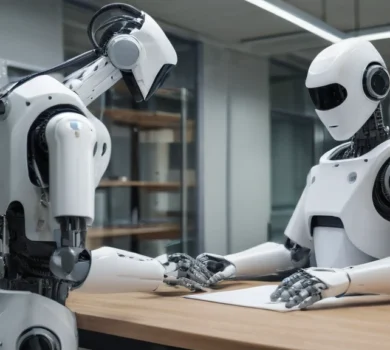
How robots learn to improve in real time through critiques and residual flows.
A new approach to robotics, based on residual flow and level-of-detail criticism, has achieved a 66% success rate.
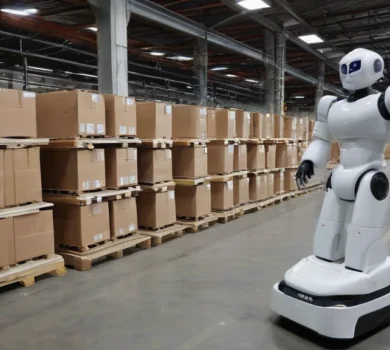
Teradyne Robotics and Sereact have implemented physical AI in Zalando’s logistics centers.
At Zalando’s logistics centers in Greven and Świebodzin, collaborative robots working with the Sereact Cortex platform operate automatically.
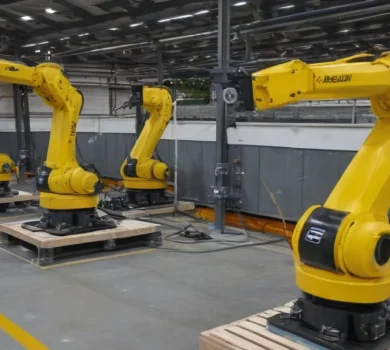
Full traceability in production thanks to robots and system integration
Atmus Filtration has implemented a modern robotic system for assembly and inspection, which ensures complete product traceability.
AGCO is testing a humanoid robot in production in Hesston, Kansas
AGCO and Agility Robotics will launch a pilot program featuring the Digit® humanoid robot at their manufacturing facility in Hesston.
How does the new diffusion model change the approach to autonomous driving?
The new QualiDrive model introduces an innovative approach to trajectory generation in autonomous vehicle guidance - instead of