

Cylindrical Robots
Precision and Stability!
Ideal for Assembly and Processing
Compact Solution for Automation
Linear and rotary motion in one system
Cylindrical Robots - Efficiency in Action
Precise operations in confined spaces
Cylindrical robots combine linear and rotational motion, making them ideal for precise operations in confined spaces. Used in assembly, processing and welding, they provide stability, accuracy and efficiency in industrial process automation.
Contact us Watch the videoSimple Kinematics for Specialized Tasks
Cylindrical Robots
Cylindrical robots, also known as column robots, are distinguished by a kinematic system based primarily on movement rotating around the vertical axis and linear along the Z axis. They often also have an additional reach axis that allows them to precisely dose, pick, or place components a short distance from the column. This mechanical arrangement makes a cylindrical robot highly suitable for tasks requiring regular rotation and up-down movement, especially when production stations are arranged radially around the rotation axis.
Why Consider Cylindrical Robots?
Simple Design and Low Maintenance Costs: Fewer complex joints and simpler drives reduce the number of potential failures and lower servicing costs.
Ease of Integration: Thanks to a limited number of movements, rotation plus vertical movement and optionally reach, a cylindrical robot can be easier to program and faster to deploy in repetitive rotary applications.
Space Savings: The column design occupies little horizontal space, which can be an advantage in confined halls or densely arranged workstations.
Cylindrical Robots
Design and Operating Principle
Unlike Cartesian or articulated robots, cylindrical robots are characterized by a vertical column, or Z axis, and the ability to rotate around this axis. Many designs also add radial extension, allowing a tool such as a gripper to move horizontally.
Mechanical Design
- Column (Z Axis) The robot is based on a vertical column along which an arm or carriage moves. This enables upward and downward movement, allowing components to be picked up or placed at different levels.
- Rotation Axis Most commonly located at the base of the column, it allows the robot to rotate in the horizontal plane. This enables one robot arm to serve several workstations arranged around it. Reach / Radius (optional)
- Reach / Radius (optional) Allows the tool, such as a gripper or sensor, to move farther from the column axis, increasing the robot's horizontal reach. In some designs, this may be an additional linear or rotary axis.
Drive and Control
- Stepper Motors or Servo Drives They control movement on the rotational axis and vertical Z axis. Depending on accuracy requirements, stepper motors are used for lower cost but limited precision, or servo drives for greater precision and dynamics.
- Controllers and HMI Panels Cylindrical robots can be operated using standard PLCs or dedicated manufacturer controllers. The software is usually less complex than for articulated robots, which makes implementation easier.
- Sensors and Safety Systems Depending on the application, limit switches, light curtains or vision systems can be integrated. Simple safety solutions are often sufficient if the robot operates within a separated zone.
Movement Method
- Complex Cylindrical Motion A cylindrical robot combines linear movement along the vertical axis with rotation around its own base. This combination allows it to serve multiple workstations arranged around the robot, making it an ideal solution for processes requiring flexibility and repeatability.
- Precise Manipulation Thanks to adjustable arm reach, a cylindrical robot can operate at different radii from its main axis. This makes it possible to adapt movement to the specifics of the process, from simple part transport to more precise tasks such as packaging or assembly.
- Limited number of axes: typically 2-3 degrees of freedom, rotation + vertical movement + radius, compared with up to 6 in articulated robots.
- Ease of Maintenance: fewer connection points and mechanical joints mean fewer components requiring maintenance.
- Intuitive programming: movements defined along one rotational axis and the vertical axis (plus optional reach) are relatively simple to program.
Key Advantages
Key Advantages of Cylindrical Robots
Cylindrical robots may seem less versatile than articulated or Cartesian robots, but they have a number of features that make them highly attractive for selected applications:
- Compact and Stable Design The main column takes up very little horizontal space. This allows the robot to be positioned close to other machines without taking up valuable floor space in the production hall.
- Low Operating Costs Fewer joints and a simplified mechanical layout reduce the number of parts that may wear out. This usually means lower servicing and spare-parts costs.
- Ease of Operation and Configuration Simple kinematics means a shorter learning curve for operators and engineers. Advanced offline systems or 3D simulations are often unnecessary for programming the basic movements of a cylindrical robot.
- Stability in Rotation-Vertical Movement For tasks requiring regular rotation around its own axis and vertical movement, such as dispensing or picking components from a drum, a cylindrical robot provides highly repeatable results.
Industrial Applications
Cylindrical Robots
Although cylindrical robots may appear less kinematically advanced than their articulated or Cartesian counterparts, in some processes they are virtually indispensable. Below we present the most common areas of their use:
Rotation and Dispensing
Rotary Fluid Dosing
When a dispensing unit must rotate around a central axis and move vertically along Z, a cylindrical robot provides simplicity and repeatability.
Automatic application of substances
Paints, adhesives, lubricants - dispensing along the vertical axis and rotation to distribute the medium evenly over a rotating component.
Rotating Machines and Drums
Picking Parts from a Drum
In processes where components are randomly placed in a rotating drum, a cylindrical robot can rotate around the column axis, move vertically, and efficiently extract parts.
Radial Sorting
If workstations are arranged around the robot, a column robot can easily switch between points using rotational and vertical movement.
Simple Assembly Applications
Vertical stacking of components
When precise up-and-down movement and rotation are sufficient to fit parts into prepared sockets.
Tightening Screws or Nuts
Limited rotation and height adjustment may be sufficient for uniform assembly processes without the need for complex multi-plane maneuvering.
Machine Tending
Vertical load
A cylindrical robot can pick up raw materials from one zone, lift them along Z, rotate, and then place them into a processing machine or at the next workstation.
Loading and unloading
Thanks to its simple movements, it works well with machines arranged in a circular layout or within a small work area where operators want to automate only a specific activity.
Quality Control and Testing
Positioning a camera or sensor
Limited rotation and vertical movement may be sufficient for sequential inspection of several points on a given part.
Simple pressing or tightening tests
When repeatable pressure force along the Z axis and the ability to rotate a component by a selected angle are important.
Cylindrical Robots
Industries Where Cylindrical Robots Are Most Commonly Used
Thanks to simple kinematics and stable vertical and rotational movements, cylindrical robots are used in various industries. Below are several examples of sectors where this robot type is especially valued:

Picking small parts from a drum and placing them on an assembly conveyor.
Dispensing solder paste or placing small components along the vertical axis.

Handling products from rotating drums, for example in packaging or sorting processes.
Applying additives or seasonings in a uniform, vertical dispensing motion.

Dosing liquids such as perfumes, creams, or detergents using rotary and vertical motion.
Picking up and placing bottles or jars arranged around the robot's axis.

Picking vials from circular magazines, dosing medicines, sealing and labeling packages.
Quality control by press fitting or contact-force measurement.


Rotational manipulation of samples, dispensing reagents along the vertical axis.
Test applications requiring repeated pressing or strength testing within a limited range of motion.
In industries where repetitive rotary and vertical movement is important and the process does not require complex trajectories or high payloads, cylindrical robots perform exceptionally well, reducing automation costs and accelerating the implementation of new production lines.
Cylindrical Robots
Technical Requirements and Integration
Cylindrical robots, although they have relatively simple kinematics, still require proper adaptation to working conditions and correct integration with the production line. Below are the key aspects worth considering before implementation:
Operating Parameters
Rotation Range
How large a rotation angle is needed to handle items arranged around the station? Some models offer rotation up to 360 degrees, while others allow full repeated rotations.
Payload and Speed
Although typical cylindrical robots are used with smaller loads, it is worth checking the maximum payload on the vertical Z axis. Permissible rotational speed is also important to avoid vibration during faster cycles.
Accuracy and Repeatability
In some processes (e.g., dispensing, testing), high precision is required in setting the Z-axis and rotation angle. The repeatability parameter is usually given in millimeters or micrometers.
Integration with Control Systems
PLC and Communication Protocol
Cylindrical robots often work with popular protocols such as EtherCAT, Profinet, and Modbus. For simple applications, a standard PLC controlling the Z axis and rotary axis is sufficient.
Software and Programming
Suppliers usually provide their own environment for creating paths, although standard sequential PLC programming is often sufficient. Thanks to the limited number of axes, programming can be very intuitive.
Safety and Sensors
If no people are expected to be present in the robot's work zone, standard fencing or light curtains are sufficient. In more complex applications, such as tool changing, additional positioning sensors or a vision system should be considered.
Environmental Conditions
Temperature and Humidity
Cylindrical robots must be adapted to the conditions of the production environment, such as cold-storage areas in the food industry or higher humidity in laboratories.
Dust and Contamination
If the process generates dust, chips, or metal particles, suitable guards and seals should be used, for example an IP rating appropriate to the conditions.
Industry 4.0 Compatibility
When working with IoT systems that collect robot operating data, check whether the cylindrical robot can be equipped with communication modules for remote monitoring and diagnostics.
Cylindrical Robots
Comparison with Other Robot Types
Cylindrical robots are machines with a simple and efficient design that enables movement within a cylindrical coordinate system: rotation, vertical movement, and optional reach. With a small number of axes, usually 2-3, they are exceptionally easy to operate, maintain, and program. They are an ideal solution for applications requiring repeatability, precision, and reliable performance. To fully understand their capabilities and choose the best technology for your processes, it is worth comparing them with other robot types, such as Cartesian, SCARA, articulated, Delta, collaborative cobots, or Gantry robots.
Cylindrical Robots vs. Cartesian (XYZ)
Kinematics and Range of Motion
Cylindrical robots combine rotary motion around a vertical axis with linear motion along that axis, Z, and often an additional radial reach axis. Cartesian robots, XYZ, operate along three linear axes, making simple motion paths, for example along X, Y, and Z, easier to define. Cylindrical robots can be more compact around the rotary axis, while Cartesian systems often occupy more planar space but provide clear, orthogonal movement.
Applications
Cylindrical robots are selected where parts or workstations are arranged around an axis of rotation, for example in machines that service a cylindrical chamber or in pick, rotate, and then lift along the Z-axis applications. Cartesian XYZ robots perform very well in processes requiring long, straight movements, such as 3D printing, milling, or precise pick-and-place over a large working area.
When to Choose?
If you need a simple and reliable robot for rotational movement around an axis together with vertical Z movement, and workstations are arranged around it, a cylindrical robot may be sufficient and economical. If you have a large X-Y work area and repeatability in linear movements is critical, a Cartesian XYZ robot will be more versatile.
Cylindrical Robots vs. SCARA
Design and Dynamics
SCARA robots have two rotary joints in the horizontal plane and a rigid vertical Z axis, which gives them very high speed and precision in assembly or pick-and-place tasks. Cylindrical robots, although they can also rotate around their own axis, usually do not achieve the same horizontal dynamics, focusing instead on servicing workstations arranged around them and on vertical movement.
Applications and Typical Advantages
SCARA robots excel at rapid part transfer and assembly of small components, especially where space is limited. Cylindrical robots, by contrast, are suitable for applications where less complex kinematics, rotation plus reach plus vertical motion, are sufficient, for example in simple dispensing lines or machine loading where parts are arranged around the robot. SCARA robots generally require a precisely designed planar trajectory, but offer higher speed and cycle repeatability.
When to Choose?
If your application requires extremely short cycle times and work mainly in a single plane, for example fastening small components or pick and place, SCARA will be the better choice. If parts are arranged around the robot and the task requires a simple rotation through a certain angle plus movement along the vertical Z axis, a cylindrical robot may be sufficient and less expensive to maintain.
Cylindrical Robots vs. Articulated (Robotic Arms)
Degrees of Freedom and Range of Motion
Articulated robots have 4 to 6 rotary axes, providing impressive flexibility and allowing complex trajectories across multiple planes. Cylindrical robots mainly offer rotation around their own axis plus vertical Z-axis movement, sometimes with additional radial reach. As a result, the cylindrical range of motion is significantly more limited than that of articulated robots.
Applications
Articulated robots perform very well in tasks such as welding, painting, multi-orientation assembly, and CNC machine tending. Cylindrical robots are more suitable where vertical motion and limited rotation are sufficient, for example picking parts from a rotating drum and transferring them to one or two stations around the perimeter.
When to Choose?
If you need versatility and the ability to work in many spatial directions, an articulated robot is difficult to match. If the application requires only vertical movement and rotation around the base, a cylindrical robot can perform the task in a simpler and less expensive way.
Cylindrical Robots vs. Delta
Kinematics and Range of Motion
Delta robots use advanced kinematics based on three or four arms attached to a common platform positioned above the work area. This enables them to achieve exceptionally high speeds when handling small components. Cylindrical robots rotate around a vertical axis and can move along the Z axis, optionally with radial extension, which gives them a more limited range of motion and generally lower dynamics.
Applications and Characteristics
Delta robots dominate ultra-short pick & place cycles, mainly with lightweight objects, for example in the food or pharmaceutical industry. Cylindrical robots are better suited to simpler tasks. They can rotate around their own axis, pick up a component from one station, and move it to another, especially when stations are arranged in a circle. However, they cannot achieve the extremely high speeds and dynamic precision of Delta robots.
When to Choose?
If the priority is extremely fast transfer of small parts (hundreds of cycles per minute), choose a Delta robot. If the process is less dynamic and requires only vertical rotation and a simple path (e.g. up-down) without complex kinematics, a cylindrical robot will be sufficient and often less expensive to operate.
Cylindrical Robots vs. Cobots (Collaborative Robots)
Safety and Operator Interaction
Cobots were created for direct cooperation with people (collaborative robots). They have built-in advanced safety systems that detect collisions and allow them to work side by side with an operator. Cylindrical robots are classic industrial designs that usually require guarding or light curtains when operating at higher speeds or payloads.
Applications
For tasks requiring human-robot interaction, such as assembly assistance where a robot hands components to an operator, cobots have an advantage due to built-in safety mechanisms and rapid reprogramming. Cylindrical robots perform best in fixed, repetitive rotary and vertical movements where a person does not need to remain close to the work zone.
When to Choose?
If safe operation alongside an operator and fast workstation changeovers for different tasks are essential, choose cobots. If the process requires only simple axial movements and rotation and the workstation can be fenced off, a cylindrical robot will be a simpler and often less expensive solution.
Cylindrical Robots vs. Gantry Robots
Design and Work Area
Gantry systems are based on several linear axes, often on a large scale, for example with a crane moving above an entire hall. They enable heavy or oversized components to be transported between many points distributed over a large area. A cylindrical robot has a more compact design, with a column featuring a rotary axis and a Z-axis guide, making it ideal for applications where workstations are arranged in a circle within a relatively small area.
Applications
Gantry robots operate on a distinctly larger scale and are often found in high-bay warehouses, the steel industry and production lines handling large loads. Cylindrical robots are usually smaller and intended for tasks such as picking a part from a drum, rotating it to a specified angle, positioning it on the vertical axis and transferring it to the next station.
When to Choose?
Gantry robots work well where long reach and handling of heavy components over a large area are required. However, if you want to automate processes in a small area designed around a rotation axis, a cylindrical robot may be sufficient and much simpler to install.
Cylindrical robots offer simple kinematics well suited to rotational and vertical tasks within a limited area. They are an economical and reliable solution for many pick-and-place processes arranged in a circular layout. However, if the priority is ultra-fast pick and place, collaboration with an operator, or coverage of very large areas, other robots such as Delta, cobots, or Gantry systems may be more effective. The choice always depends on the process characteristics, range of motion, and required operating parameters.
Frequently Asked Questions
Frequently Asked Questions About Cylindrical Robots
Cylindrical models are generally intended for light and medium loads, although versions with somewhat higher payloads are available. If high payload is critical, Gantry solutions or reinforced articulated robots are worth considering.
This depends on the drives used, whether servo or stepper, and on the gearboxes. In most cases, accuracy on the order of hundredths of a degree can be achieved, which is fully sufficient for dispensing and assembly applications.
A PLC controller and simple movement sequences, rotation, Z-axis travel, and possibly radial extension, are often sufficient. Some companies provide their own software with a graphical interface, but for simple operations programming is usually less complex than, for example, with articulated robots.
The column design enables a compact installation. The entire robot "housing" usually occupies little space around the axis, although a safety zone must be considered if the robot rotates at high speed.
Thanks to the simplified mechanical system, servicing can be relatively easy. Periodic inspection of bearings in the rotary axis and guides in the Z axis, lubrication of components, and checking the seals of protective covers are required.
Yes, provided it offers sufficient rigidity along the Z axis and has programmed force parameters, which can be controlled, for example, using a servo motor with a torque sensor. If you need more complex movements, such as motion in multiple planes, consider an articulated robot.
Many models allow an additional rotary gripper or rotary tool such as a screwdriver to be added. This gives the robot an additional R axis, although it is not standard in every design.
It depends on payload mass, inertia, and drive power. Compared with SCARA or Delta robots, cylindrical robots do not reach such extreme speeds, but they are usually sufficient for standard pick & place, dosing, and machine-tending tasks.
Yes, especially when common communication protocols and PLC controllers are used. It is often sufficient to match the input/output, I/O, system to line signals and write short motion sequences.
Conventional cylindrical robots are standard industrial robots and often require safety fencing. If human collaboration in the same space is important, dedicated cobots are worth considering because they include built-in safety systems such as force and torque sensors and are designed for direct interaction.

Do you have more questions?
Contact us or visit the FAQ section for detailed answers to all questions about cylindrical robots.
Why NexaRob?
Choosing the right industrial-robotics solution provider is essential to smooth and efficient automation. At NexaRob, we focus on comprehensive support, innovation and long-term relationships, giving customers full control over the implementation of cylindrical robots and other solutions.
- Experience Across Diverse Industries We carry out projects for companies in electronics, food, pharmaceuticals, chemicals, and many other sectors. We understand the specifics of different applications and can recommend an appropriate cylindrical robot model and matching modules, such as grippers or dispensing systems.
- Individual Approach and Consultations We begin every project with a detailed needs analysis: the workstation layout, type of components, and requirements for precision and operating speed. This allows us to deliver tailored solutions instead of imposing universal sets.
- Comprehensive Support, From Design to Service We provide support at every stage of implementation, from technology consulting and integration with the existing production line to service and operator training. As a result, an investment in cylindrical robots can quickly deliver the expected benefits.
- Innovative Technologies and Industry 4.0 Support We cooperate with manufacturers of high-quality drives and controllers, and our solutions can be easily integrated with IoT platforms or Big Data systems. This opens the way to remote monitoring, diagnostics, and continuous process improvement.
- Financing Flexibility We understand that purchasing a robot is a significant investment. That is why we offer different financing models (leasing, long-term rental, Robot-as-a-Service) to match implementation costs to your capabilities and development plans.

Explore more implementations and the results of our cooperation with customers in the Case Studies section. Contact us today and together we will develop the best automation concept!
Automate Your Business with NexaRob - Contact Us!
Global Reach
We Operate Globally, Support Locally
NexaRob is an internationally active company operating in more than 100 countries. Whether you run a local manufacturing plant or are part of a global corporation, we provide:
- Expert Knowledge and Consulting Our engineers work with customers from different industries, sharing experience and proven practices for cylindrical robot implementations around the world.
- Regional Service Support We have a network of qualified service technicians and local partners, allowing us to respond quickly to customer needs and minimize downtime.
- Flexible Solutions Tailored to Markets Knowledge of local specifics and regulations in many countries enables us to adapt projects to legal or cultural requirements (e.g. occupational safety standards, communication protocols).
By working with NexaRob, you gain not only advanced robotic technology but also proven know-how with global reach, helping ensure your implementation is comprehensive and effective regardless of location.

United States

China

Japan

Germany

India

United Kingdom

France

Italy

Canada

South Korea

Brazil

Australia

Spain

Mexico

Indonesia

Netherlands

Saudi Arabia

Turkey

Switzerland

Taiwan

Poland

Sweden

Belgium

Thailand

Ireland

Austria

Norway

Israel

United Arab Emirates

Argentina

South Africa

Denmark

Philippines

Singapore

Malaysia

Colombia

Bangladesh

Egypt

Chile

Finland

Vietnam

Portugal

Czech Republic

Romania

New Zealand

Peru

Greece

Ukraine

Slovakia

Hungary

Slovenia

Croatia

Serbia

Bulgaria

Estonia

Latvia

Lithuania

Iceland

Luxembourg

Malta

Cyprus

Morocco

Algeria

Tunisia

Nigeria

Kenya

Ethiopia

Ghana

Tanzania

Uganda

Angola

Senegal

Qatar

Kuwait

Oman

Pakistan

Sri Lanka

Nepal

Kazakhstan

Uzbekistan

Mongolia

Russia

Cambodia

Myanmar

Laos

Fiji

Papua New Guinea

Venezuela

Ecuador

Uruguay

Paraguay

Bolivia

Costa Rica

Panama

Dominican Republic

Guatemala

Cuba

Jordan

Lebanon

Iran
Additional countries in Europe
These countries are hidden in reader mode so that the map is not overcrowded. Click a country to open contact details, email and a description of the cooperation area.
Additional Countries in Asia
These countries are hidden in reader mode so that the map is not overcrowded. Click a country to open contact details, email and a description of the cooperation area.
Additional Countries in the Americas
These countries are hidden in reader mode so that the map is not overcrowded. Click a country to open contact details, email and a description of the cooperation area.
Additional Countries in Africa
These countries are hidden in reader mode so that the map is not overcrowded. Click a country to open contact details, email and a description of the cooperation area.
Additional Countries in Oceania
These countries are hidden in reader mode so that the map is not overcrowded. Click a country to open contact details, email and a description of the cooperation area.
Albania
Andorra
Belarus
Bosnia and Herzegovina
Montenegro
Liechtenstein
North Macedonia
Monaco
Moldova
San Marino
Afghanistan
Armenia
Azerbaijan
Bahrain
Bhutan
Brunei
Georgia
Iraq
Yemen
Kyrgyzstan
North Korea
Maldives
Syria
Tajikistan
Timor-Leste
Turkmenistan
Antigua and Barbuda
Bahamas
Barbados
Belize
Dominica
Grenada
Guyana
Haiti
Honduras
Jamaica
Nicaragua
Saint Kitts and Nevis
Saint Lucia
Saint Vincent and the Grenadines
El Salvador
Suriname
Trinidad and Tobago
Benin
Botswana
Burkina Faso
Burundi
Cabo Verde
Chad
Democratic Republic of the Congo
Djibouti
Eritrea
Eswatini
Gabon
Gambia
Guinea
Guinea-Bissau
Equatorial Guinea
Cameroon
Chambers
Congo
Lesotho
Liberia
Libya
Madagascar
Malawi
Mali
Mauritania
Mauritius
Mozambique
Namibia
Niger
Central African Republic
Rwanda
Seychelles
Sierra Leone
Somalia
Sudan
South Sudan
Togo
Ivory Coast
São Tomé and Príncipe
Zambia
Zimbabwe
Kiribati
Micronesia
Nauru
Palau
Samoa
Tonga
Tuvalu
Vanuatu
Marshall Islands
Solomon Islands
NexaRob
Would you like to become our Partner?
At NexaRob, we believe that in robotics and automation, synergistic cooperation between companies and specialists makes it possible to create innovative solutions that transform production processes. If you supply components, AI technologies, IoT, vision systems, or integrations for industrial robots, we invite you to cooperate with us!
Why Work with NexaRob?
Development and Innovation in the Robotics Industry
Together with our partners, we develop new modules for cylindrical robots and other robot types, allowing the offering to be continuously improved and adapted to growing market requirements.
Technical and Marketing Support
We organize technical training and webinars, and we also provide promotional materials and access to contacts in a customer base looking for automation solutions. Together, we reach new audiences.
Global Network and New Opportunities
With a presence in more than 100 countries, NexaRob provides access to markets with different characteristics. Our partners gain opportunities to introduce their own products and services under a shared commitment to quality and innovation.
Who are we looking for?
- Manufacturers or suppliers of robotic components
- Companies offering vision, AI, and IoT systems
- Integrators of specialized industrial software
- Anyone developing innovative solutions for Industry 4.0
Join NexaRob's Global Network!
Contact us so we can discuss the details of collaboration and jointly develop the future of automation, including solutions based on cylindrical robots.
Interesting Facts from Around the World

How robots learn to improve in real time through critiques and residual flows.
A new approach to robotics, based on residual flow and level-of-detail criticism, has achieved a 66% success rate.
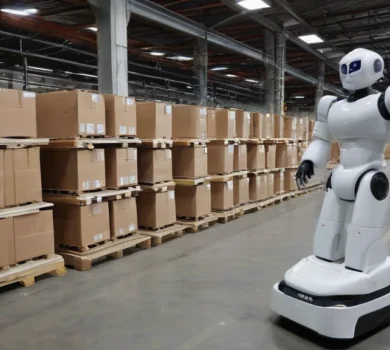
Teradyne Robotics and Sereact have implemented physical AI in Zalando’s logistics centers.
At Zalando’s logistics centers in Greven and Świebodzin, collaborative robots working with the Sereact Cortex platform operate automatically.
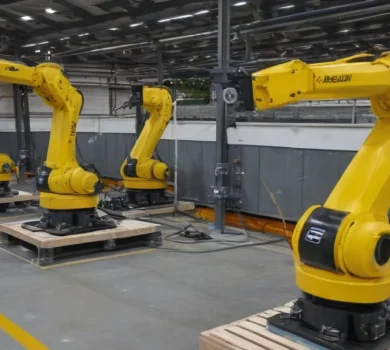
Full traceability in production thanks to robots and system integration
Atmus Filtration has implemented a modern robotic system for assembly and inspection, which ensures complete product traceability.
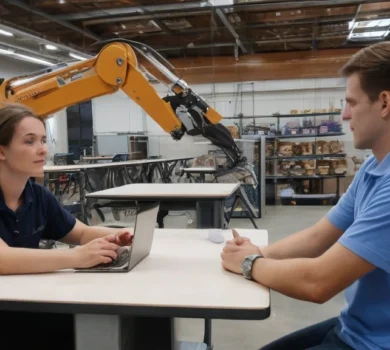
AGCO is testing a humanoid robot in production in Hesston, Kansas
AGCO and Agility Robotics will launch a pilot program featuring the Digit® humanoid robot at their manufacturing facility in Hesston.

How does the new diffusion model change the approach to autonomous driving?
The new QualiDrive model introduces an innovative approach to trajectory generation in autonomous vehicle guidance - instead of