

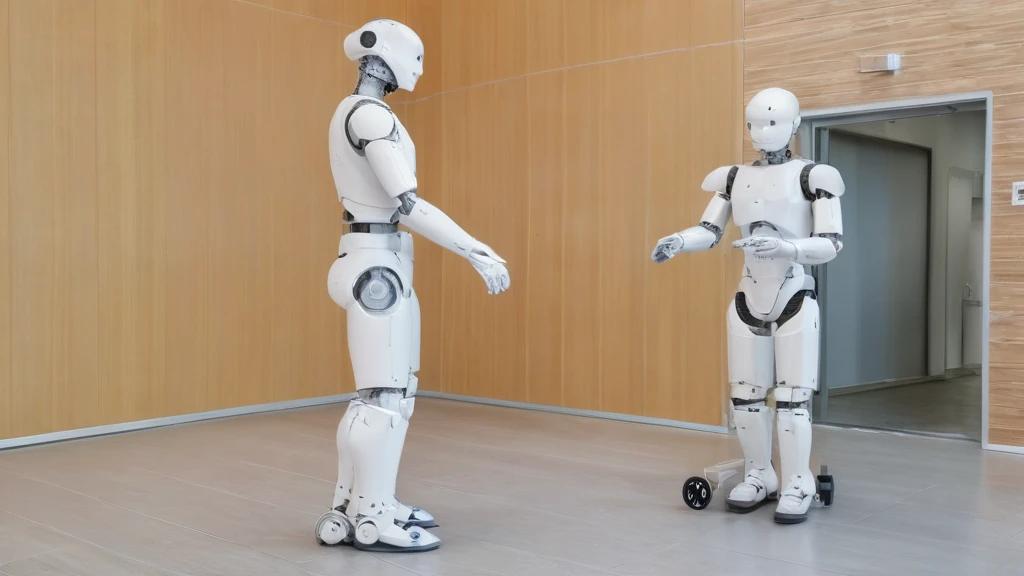
New generation of safe actuators for social robots
Research on the physical safety of human-robot interaction (pHRI) is becoming a key challenge in the development of social and service robotics. Traditional elasticity actuators based on metals often require complex, multi-part constructions, which increases production cost and complexity. A new approach, presented in the paper from arXiv, involves using 3D printing to create a torsional elastic element from thermoplastic polyurethane (TPU). This material not only allows for fast and cheap production but also offers natural vibration damping, which is crucial for safe operation in the environment.
The developed actuator is characterized by a very linear torque response - the stiffness value is 0.066 Nm/degree. Experimental studies confirmed that the actual response differs from numerical predictions (FEA) by less than 3%. The difference was attributed to the anisotropy of the structure resulting from FDM printing technology. This allows for precise modeling of the actuator's behavior, which is important for designing control systems.
Hybrid controller and safe real-time interaction
To enable operation with existing positional motors that are not designed to operate in force mode, a hybrid position controller with torque threshold switching was designed. The system operates in position mode during normal operation, but automatically switches to torque limiting mode when it detects an external disturbance. This allows for safe yielding under contact with a human or object.
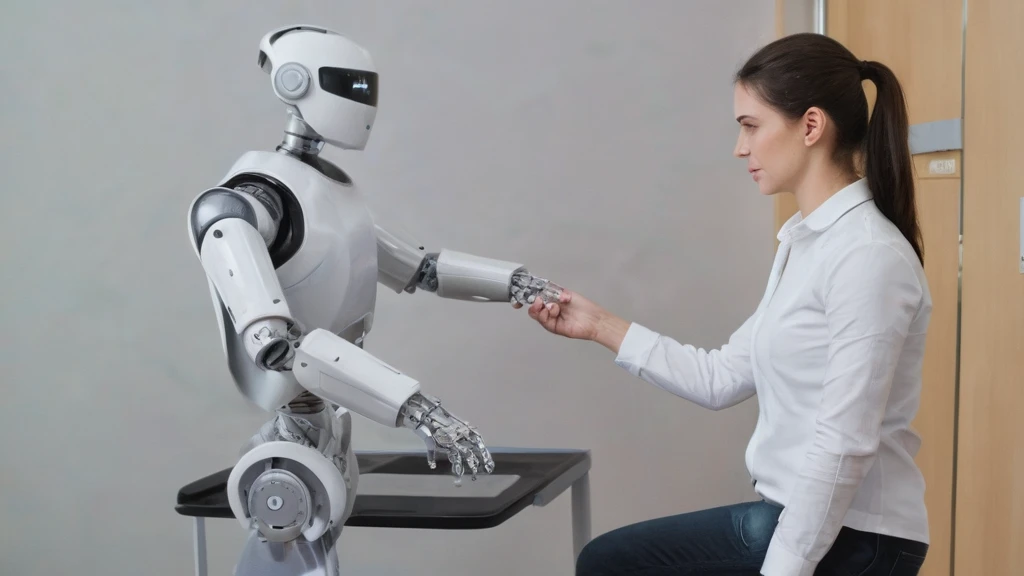
Experiments confirmed the system's ability to track non-stationary trajectories - i.e., movements that are not constant over time - without loss of stability. Furthermore, the actuator demonstrated the ability to safely respond to external forces, which is a key requirement for robots operating in close contact with humans. Such a solution may be particularly useful in rehabilitation or assistive applications.
 Enlarged imageClose zoomPrevious image
Passive damping as a natural material feature
One of the most important discoveries is the role of internal TPU material damping. Unlike metal springs, which can cause vibrations during transitions between control modes, polyurethane acts as a passive low-pass filter. This means that high-frequency vibrations are automatically damped without the need for additional control algorithms.
This feature is particularly important in applications where smoothness of movement is critical - e.g., when touching a patient or handling delicate objects. The lack of a need for additional damping means less system complexity and lower risk of control errors, which translates into greater reliability.
Significance for the future of safe robotics
The developed actuator is an example of a modern approach to designing human-robot interaction systems. Thanks to its low stiffness, linearity and natural damping, it can be used in a wide range of applications - from assistive robots at home to rehabilitation devices. Its production using 3D printing means low prototyping costs and the possibility of rapid customization. Related topic: Medical Robots.
It is worth emphasizing that the study concerned experimental validation - i.e., demonstrating its operation in a laboratory. There is no information about actual implementation or tests in a real environment. Therefore, although the results are promising, their scalability and durability over a long period remain unconfirmed. Further research should focus on assessing cyclic endurance and the impact of environmental conditions on material behavior.
The significance of this solution goes beyond a single application - it opens up new possibilities for designing robots intended for collaboration with humans in everyday conditions. Thanks to its low stiffness and natural damping, the actuator can be used in systems that require gentleness and precision, such as robots assisting elderly people, physical therapy devices or interactions in education. It is worth emphasizing that its production using 3D printing enables rapid prototyping and adaptation to individual user needs, which is crucial for the development of personalized robotics.
Although the study was conducted under laboratory conditions, its results suggest the potential for scaling up in industry and medical applications. Further research should focus on assessing the cyclic endurance of the TPU material and the impact of environmental conditions, such as temperature or humidity, on the long-term stability of the actuator's operation. This will allow moving from experimental results to real solutions implemented in the real world.