

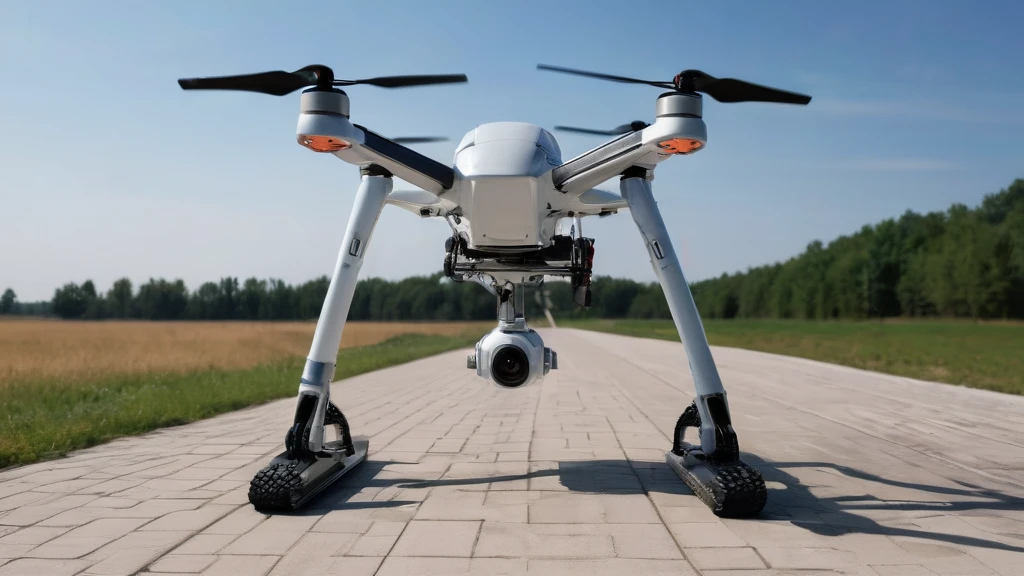
The new era of robotics: from biomimicry to practical solutions.
Modern robotic systems are no longer limited to simple, low-cost devices. As the Technology Innovation Institute (TII) points out, today a "cheap" robot does not have to be "limited." New possibilities in edge computing, artificial intelligence, and communication allow for the creation of devices that are both easy to maintain and efficient in operation. This changes the entire logic of robot design - it is no longer about imitating a flock of birds or a school of fish, but about creating systems that can operate in real conditions without the need for central control.
TII emphasizes that classic swarm robotics, based on biomimicry, was often too theoretical and disconnected from practical needs. Many systems labeled as "swarms" actually operated under the control of a single computer - which eliminates the principle of decentralization. The new approach developed by TII is not guided by perfect imitation of nature, but focuses on solutions that are fault-tolerant, scalable, and operate without constant operator supervision.
Principles of operation: decentralization, local interactions and self-organization.
TII bases its research on three key principles of swarm robotics. The first is decentralization - the system does not depend on a single operator or control unit. Each robot in the swarm analyzes its surroundings locally and makes decisions without having to consult with a central system. This eliminates a single point of failure and allows for rapid response to changes in the environment.
The second principle is local interaction - robots cooperate only with the nearest neighbors, using simple rules stored in their processor. They do not require complex planning in advance or continuous communication with a central system. The third - self-organization - means that the swarm can spontaneously organize and coordinate without a pre-planned structure. This allows for long-term operation even in difficult conditions, such as during rescue operations or environmental monitoring.
Real-world applications: from rescue operations to logistics
TII is developing solutions for three main environments: air (drones), land (unmanned vehicles), and sea (surface and underwater vessels). In each of these areas, robot swarms can operate independently, are fault-tolerant, and can scale in real time. For example, in the event of a natural disaster, a swarm of drones can automatically deploy over the search area, analyzing the terrain without the need for central management.
In logistics and industry, TII emphasizes that the new approach avoids the limitations of systems based on a single controller. If one robot fails, the rest continue to operate - which is crucial in high-risk environments. Unlike traditional systems that require continuous monitoring and pre-programming, the new swarms are more flexible and resilient to changing conditions.
Is it really a swarm? Limitations and controversies
Although TII emphasizes that the new systems are "true" robot swarms, it is worth noting that not all of their claims have been confirmed by independent tests. Everything in the text is based on the organization's statements and its vision. There is no information about specific demonstrations, pilots, or actual deployments. Therefore, it is not yet possible to talk about full implementation - this is a direction of development, not a ready-made solution.
In addition, although TII speaks of "autonomous decision-making at the local level," it does not provide details on how the decision-making algorithm works or what its limitations are. There is a lack of data on performance under interference conditions, security measures, or reaction to cyberattacks. This remains unclear and requires further research.
Prospects: robot swarms as a partner for industry and government
TII sees the future of robot swarms as a key partner for the industrial sector and government institutions. In areas such as national security, environmental monitoring, and rescue operations, autonomous systems can operate without continuous human involvement, increasing efficiency and safety.
The benefits are obvious: lower maintenance costs, greater fault tolerance, and scalability. However, the key challenge remains ensuring safety, transparency of decisions, and control over the system's operation - especially when robots make decisions without human intervention. TII does not yet provide detailed solutions in this area, but this is one of the main challenges for the future.