

Humanoid Robot Models
The most advanced humanoids in one place
The future of humanoid robotics
Robots inspired by human anatomy
AI technology in humanoid forms
Overview of advanced designs
Discover the humanoid robots of the future
Humanoid robots are innovative designs that combine artificial intelligence with precise mechanics. On this page, you will find an overview of the most modern models that set the direction for robotics development - from home assistants to advanced humanoids for industry and science.
Contact us Watch the videoHumanoid Robot Models
Overview of Achievements in Modern Robotics
Welcome to our Robopedia dedicated to humanoid designs from around the world. Here you will find comprehensive information about various robots imitating the human figure, how they work, and their potential applications - from education to service industries. The purpose of this subpage is to collect and systematize models that already set standards in the field of robotics inspired by humans, while also opening the way for completely new forms of interaction between humans and machines.
Diversity of Solutions: The catalog includes both simple educational versions and advanced humanoids with a rich set of sensors, arms, and AI tools that can serve as versatile assistants in offices, homes, or public spaces.
Basis for In-Depth Analysis: You will learn not only the technical parameters and functions of robots but also examples of implementations, safety aspects, and tips on integrating them with existing infrastructure.
Why are humanoids generating so much interest?
Because their shape and way of moving are closest to an environment adapted to human needs. As a result, they can perform tasks where we previously used the help of people or complex automatons that were not suitable for spaces designed for the human figure.
Robopedia
How to Use Our Catalog?
The list we have compiled includes key models of humanoid robots, descriptions of their capabilities, and practical implementation tips. Thanks to its user-friendly structure, you can quickly find the solutions that match your plans or vision for the future of robotics in your company, organization, or home environment.
Overview of Main Functions and Parameters
- Each description begins with a brief introduction indicating the most important physical characteristics (height, weight, number of degrees of freedom), type of drive, or AI modules used.
- It also includes information on how it moves, its ability to carry objects, or voice interaction options.
Application examples
- In the applications section, you will learn how a given humanoid performs in the education, retail, senior care industries, or as an attraction during promotional events.
- Many robot manufacturers offer customization - our notes indicate to what extent it is possible to customize the appearance, software, or additional accessories.
Ethics and Safety
- In the description of most models, we address safety issues (anti-collision mechanisms, force limiters in joints) and data protection. We pay particular attention to robots equipped with facial recognition or advanced communication features.
- You can also find out what standards and certificates a given humanoid meets, which is often crucial for implementations in public institutions or environments with increased hygiene and safety requirements.
- We also suggest contacting NexaRob experts who will support you in analyzing your needs, implementing and integrating the robot into the work environment or home.
By using this catalog, you will gain an overview of achievements in the field of humanoid robots and tips that will help you choose and implement a solution tailored to your needs. We encourage you to explore individual models, and if you have any questions, please contact us to discuss further steps related to integrating humanoid robotics into your company, school or home. NexaRobto discuss further steps related to the integration of humanoid robotics in your company, school or home.
Humanoid Robots
Humanoid Robot Models
We present six humanoid robot models that are likely to be among the first available for retail sale in the global market. These are examples of innovative projects, representing various application possibilities - from supporting everyday household tasks to advanced industrial solutions.
Note: The price provided is indicative and based on available industry estimates - for accurate data, please refer to official announcements.
Key Selection Criteria
What Should You Pay Attention To When Choosing a Humanoid Robot?
Although many humanoid models may look similar, in practice they differ significantly in terms of technical capabilities, software and potential applications. Therefore, before making a decision to introduce a robot into a company, educational institution or home, it is worth considering several key aspects:
Range of Motion and Degrees of Freedom
- The more axes of rotation and joints, the more complex tasks the robot can perform (e.g., manipulating objects, handing over documents, assisting in warehouse organization).
- When evaluating, consider whether the robot moves only within a limited range (e.g., head and arm movements) or can also walk stably and bend down.
Height, Weight and Dimensions
- Larger humanoids (similar in size to an adult) will work well in environments designed on a human scale (doors, handles, furniture at a specific height).
- Smaller designs may be more convenient for educational demonstrations or presentations, but often have limited lifting capacity and fewer manipulation functions.
Integration with Software and AI Systems
- An open platform (SDK) allows you to expand functionality and create your own applications. If you are planning an unusual application (e.g., specific communication in a hotel or production line service), support for custom solutions will be crucial.
- Check how the robot processes data (locally vs. in the cloud) and what security protocols apply, especially if it stores information about customers or employees.
Power Supply and Autonomy
- Battery life and charging method (docking station, manual connection) may be important, especially if the robot is to operate continuously (e.g., in a reception area) or in an unstable environment.
- It is worth asking about the energy management system, whether the humanoid automatically "returns" to the charger, and how long it takes for a full battery recharge cycle.
Safety and Anti-Collision Mechanisms
- A robot designed to work with people should have built-in sensors to prevent collisions, as well as torque limiters on actuators (especially important when interacting with children or the elderly).
- Reliable information about certifications and safety tests demonstrates the maturity of the solution.
Technical Support and Service
- Check if the manufacturer or distributor offers training, documentation, and support for integration with existing infrastructure (e.g., IoT).
- Good after-sales care guarantees quick repairs in case of failure and the possibility of software updates, which allows you to keep up with technological developments.
Properly matching the robot's characteristics to the needs of a specific environment makes it easier to avoid disappointment and better utilize the potential that humanoids offer. For each item in our catalog, you will find information that will allow you to quickly assess whether a given model meets your expectations.
Examples of Implementations and NexaRob Support
How to Develop a Project with a Humanoid?
Once you have preliminarily selected a humanoid model that meets your needs, the next step is to consider how to integrate it into daily processes in an enterprise, institution, or home environment. This is where the role of an experienced integrator comes into play, who will help from the conceptual phase through full implementation and after-sales support.
Analysis of Needs and Environmental Conditions
- For companies: Identifying areas where the robot can relieve employees (e.g., repetitive tasks, guest service, sales presentations) or add value (e.g., attracting attention in marketing activities).
- In the context of education and science: Defining educational goals (e.g., programming lessons, robotics popularization demonstrations), safety requirements, and the planned level of task complexity.
Integration and Modification Project
- Implementations in the service or industrial sector often require adapting the robot's software (e.g., communication interfaces with a reservation system, IoT, ERP).
- Some humanoids allow for customization of appearance to fit into the visual identity of the company or environment (e.g., matching colors, displaying a logo).
Testing Phase (Pilot)
- Starting with a limited implementation on a small scale (e.g., a robot as an attraction in a welcome area) allows you to examine user reactions and assess whether the robot's functions actually work in everyday practice.
- Reporting errors and the need to make changes to the configuration (e.g., adjusting gripper forces, learning to recognize the local dialect) is a natural stage that helps improve and refine the final solution.
Scaling and Further Development
- If the pilot project is successful, you can consider increasing the number of humanoids or expanding their functions - e.g., implementing manipulation arms, better AI algorithms for understanding voice commands, or integration with security systems.
- Regular software updates and participation in training programs ensure that the robot remains compliant with new standards and can perform increasingly advanced tasks.
Integrator Support
- NexaRob, thanks to cooperation with manufacturers from around the world, offers advice on selecting a robot model, optimizing costs, or assisting with applying for grants for innovative projects.
- As an integrator, we ensure that the implementation runs smoothly: from configuration and testing to after-sales service (service, parts replacement, system updates).
Implementing a humanoid can be a multi-stage process, but when properly planned and executed, it can bring significant benefits - from new quality of interaction with customers to support in everyday tasks. Whether it's marketing, education, care or industrial tasks - the right robot model and proper integration determine the success of the project.
Wide Range of Applications
From Education to Advanced Services
Modern humanoids can go far beyond the role of technological curiosities. Thanks to advanced AI algorithms, mobility and object manipulation capabilities, as well as easy integration with various systems, these robots can find applications in a wide range of business areas:
Education and Training
- Programming Education: In educational institutions and universities, humanoids are becoming an interactive platform where students can learn the principles of coding, mechanics or human-robot communication.
- Demonstration Shows: During workshops or popular science events, a humanoid robot effectively attracts attention while explaining the operation of sensors or algorithms that control its movement.
Customer Service and Support
- Reception and Information Points: The robot greets guests, answers simple questions and can indicate the way to a specific department or room. It enhances the image of the institution as a place open to innovation.
- Event and Trade Fair Support: Thanks to the ability to interact with the audience (speech, gestures, displaying messages), the robot attracts visitors, making it an attractive marketing and promotional solution.
Care and Assistance in Everyday Tasks
- Support for Seniors and People with Mobility Impairments: Some humanoids have features such as medication reminders, assistance with bringing small items, or communication in emergency situations.
- Home Assistant: In smart homes, a humanoid can act as an interface for controlling IoT devices, check the status of household members, and react in case of danger or need for support.
Research and Development
- R&D Platform: Companies and institutions can use humanoids to test artificial intelligence algorithms, robotic manipulation, or machine learning capabilities in an environment that resembles human conditions.
- Integration Projects: Many manufacturers offer an open development environment (SDK), enabling the expansion of functionality. Thanks to this, the robot can become part of a larger ecosystem (e.g., warehouse or logistics systems).
Entertainment and Marketing
- Animations and Shows: A humanoid design capable of imitating human gestures and dance sequences is not only effective in attracting attention but also works well as a thematic attraction.
- Image Personalization: In some implementations, it is possible to customize the robot's facial appearance or its voice "personality" to match the style of the company's brand or the nature of the event.
Thanks to their wide range of adaptation possibilities, humanoids can perform tasks in many industries, gradually becoming a tool useful not only for robotics enthusiasts but also for businesses, educational institutions, and service providers. The right model, selected for specific needs, can contribute to significant process improvements and enrichment of the offer.
Challenges and Best Practices
How to Effectively Introduce Humanoids into Daily Use?
Implementing humanoid robots - even those described in our catalog - requires a well-thought-out strategy and an understanding of certain limitations. Below, we present key issues that should be considered to avoid disappointment and fully utilize the potential of humanoid robotics.
Identifying Needs and Defining Goals
- Precise Task Specification: Are you planning to use the robot for interactive demonstrations, customer service, or research and development tasks? Clearly defining the functions and role of the humanoid facilitates the selection of a model and the design of its implementation.
- Cost-Benefit Analysis: Consider what benefits (financial, reputational, educational) you want to achieve. Compare them with the costs of purchase, maintenance, and necessary upgrades to the space (e.g., access to charging, overcoming architectural barriers).
Infrastructure and Safety Planning
- Environment Preparation: The height of the rooms, the type of flooring, or narrow passages can affect the robot's mobility and ease of operation. Ensure that the ergonomics of the space are adapted to the needs of the machine.
- User Safety: Choose a model equipped with appropriate anti-collision sensors and mechanisms that limit force in the joints. Also, ensure that employees receive training on how to safely interact with the humanoid.
Integration with IT and IoT Systems
- Connectivity and Control: Make sure that the robot supports network protocols (Wi-Fi, Bluetooth, 5G) or external cloud services. It may be necessary to implement additional communication modules or dedicated applications.
- Data Exchange and Analysis: The humanoid can generate large amounts of information (video, audio, motion statistics). Plan how this data will be stored and processed, especially in terms of compliance with data protection regulations.
Staff Training and After-Sales Service
- Technical Support: Even the most reliable robot may require maintenance or software updates. Choose suppliers with a good reputation and access to spare parts.
- Education and Adaptation: Introducing a humanoid into a team of employees or customer service is also a cultural change. It is worth planning short training sessions, presentations, or explanatory materials on how to interact with it.
Privacy and Ethics
- Thoughtful Use of Cameras and Microphones: If the robot records images or sound, rules for storing this data and any AI analysis should be developed, especially when related to identifying individuals.
- Transparent Communication of Principles: Inform employees, customers, or guests about the presence of the robot and the purpose for which it processes data (e.g., for speech recognition, navigation, interaction). Transparency builds trust and helps avoid misunderstandings.
When implementing humanoid machines on a larger scale, it is crucial to conduct a thorough analysis and provide the necessary organizational and technological support. Humanoids can become effective partners in work and interaction with people, but only if their introduction is properly coordinated with the expectations and needs of users.
Frequently Asked Questions
The Most Important Questions About Humanoid Robot Models
Even if you are browsing our catalog of humanoid robot models, you probably have questions that you would like to ask before making a decision. Below we present a set of frequently asked questions and short answers to help you quickly understand the realities of humanoid robotics.
Most advanced humanoid robots are still in the phase of intensive testing and improvement. Some of them (with more limited functionality) can be introduced into everyday tasks, e.g., in customer service, education, or demonstrations. As technology advances and production costs decrease, the number of commercial deployments will increase.
It depends on the specific model. Some designs move exclusively on two legs, using advanced balance algorithms; others are less mobile and more focused on the upper body (arms, manipulators). Some models can overcome simple obstacles or perform minor household tasks.
Usually yes - robots have built-in navigation and basic environment recognition systems. However, the degree of autonomy varies: from advanced AI algorithms allowing for free operation, to more limited solutions requiring human intervention in unusual tasks.
Much depends on the intended function. Some models aim for maximum similarity (advanced facial mimicry, smooth hand movement), while others focus on a simplified form, concentrating, for example, mainly on operating devices or educational presentations.
Yes, but the range and precision of the manipulators depend on the model. Some humanoids have only simple grippers for light objects, while others have advanced "hands" with many degrees of freedom. It is also necessary to take into account the maximum lifting capacity, which is quite limited in most cases.
Many models have an open SDK environment or dedicated software, allowing the robot to be integrated into an IoT ecosystem or cloud services. It is important to check the list of protocols supported by the selected model.
Robots designed for collaboration with humans have built-in sensors and anti-collision mechanisms. Nevertheless, caution and adult supervision are recommended - especially in the case of children. Make sure that the manufacturer provides safety standards and force limiters in the joints.
The frequency of inspections depends on the intensity of use. With standard usage, it is worth planning a service every few months. Costs depend on the availability of spare parts and the complexity of components. It is important to choose a reliable supplier with a clear technical support policy.
Many models use facial or speech recognition systems, which involves processing personal data. In this case, it is extremely important that the implemented system complies with legal regulations (e.g., GDPR) and that users are informed about how their privacy is protected.

More questions?
If you would like to learn more about humanoid robots, we invite you to browse our complete FAQ section. You will find additional questions, detailed instructions, and helpful tips there.
Why NexaRob?
NexaRob focuses on collaborating with suppliers from around the world to offer a wide range of solutions in the field of humanoid robotics. We see this as the future of automation, where machines not only perform specific tasks but also can navigate environments created for humans - from residential interiors, through schools and offices, to service areas or hotels.
- Comprehensive Support - From Analysis to Implementation We advise on choosing the most suitable robot model from our catalog, taking into account the specific needs of the industry and the client. We help with system integration: connecting to IoT platforms, data management systems, or automation tools.
- Cooperation with Trusted Partners A global network of suppliers provides access to innovative designs and technological solutions - from the simplest educational versions to advanced humanoids with arms and implemented AI. We offer models of cooperation, including wholesale purchases, which translates into more favorable investment conditions.
- Ethics and Transparency We avoid unclear agreements and ensure the privacy of users and the security of the implemented solutions, especially in the context of interaction with people. We focus on a transparent approach to collecting and processing data (e.g., audio-video recordings), supporting clients in developing guidelines and regulations that comply with regulations.
- Flexible Maintenance and Development Options We offer service, software updates and long-term consulting so that the humanoid adapts to rapidly changing technological trends. Together with the client, we develop a strategy for training personnel and expanding functionality in subsequent stages of use.
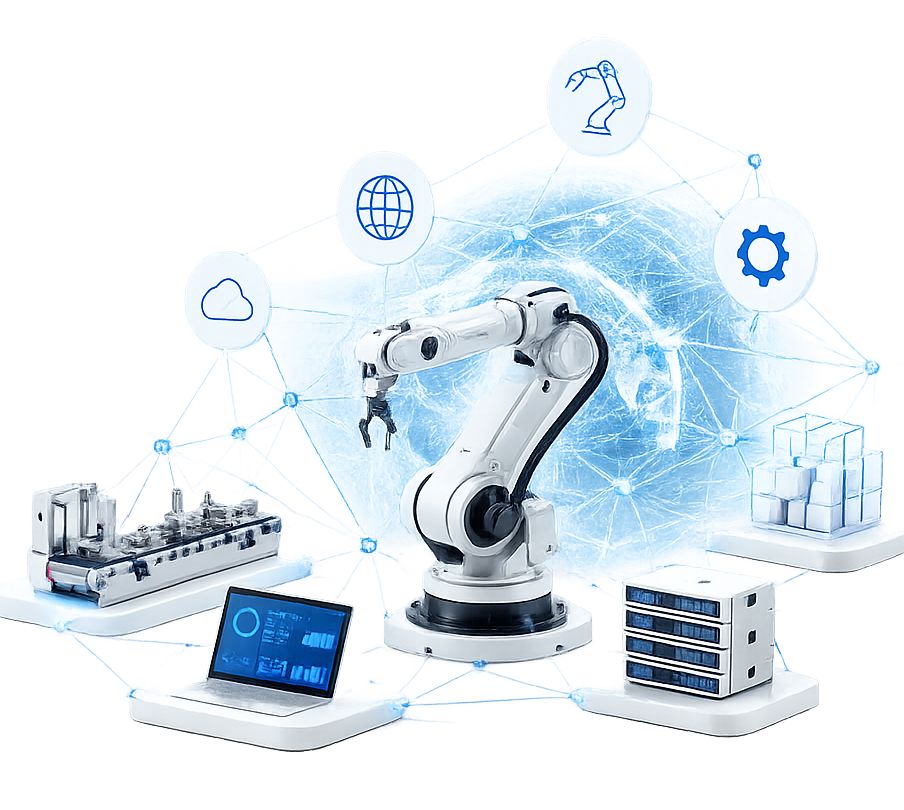
NexaRob creates a space where customers, suppliers and innovators can collaborate on the implementation of humanoid machines. We believe that these robots will help strengthen work efficiency, revolutionize education and provide new quality services, if only they are designed and implemented in a thoughtful way. Trust our integrator experience - together we will put your organization on the path of progress, where human imagination meets the power of technology.
Automate Your Business with NexaRob - Contact Us!
Global Reach
We operate globally, support locally
Humanoid technology is developing at a pace that surprises robotics industry observers. Companies from different continents - from Asia, through Europe, to America - are competing in innovation, introducing increasingly advanced control systems, artificial intelligence and human-friendly materials into their designs.
- Cross-Border Collaboration International Consortia: Many humanoid robot manufacturers collaborate with research centers, universities and integrators in many countries. This makes it possible to quickly exchange knowledge and experience, which translates into higher quality final solutions. Wholesale Orders and Cooperation: Joint international projects often mean more favorable purchasing conditions, sharing R&D costs and testing in various cultural or climatic environments.
- Adaptation to Local Requirements Cultural and Linguistic Aspects: Humanoids operating in Japan or Korea may be programmed with different behavior and interaction patterns than those intended for the USA or European countries. Safety Regulations: Each market has its own regulations regarding machines that work with people. When introducing a humanoid into a new region, it is necessary to ensure that it meets local standards (e.g., CE in Europe, FCC in the USA) and data protection regulations.
- Long-Term Development Prospects Systematic Improvements: Thanks to our global reach, you can count on regular software and hardware updates. Manufacturers often release limited editions in selected markets and then introduce unified versions after gathering user feedback. NexaRob as an Integrator: By collaborating with suppliers from different countries, we can help adapt specific humanoid models to the requirements and specifics of local markets, including post-sales support.
NexaRob
Do you want to become our Partner?
NexaRob is passionate about supporting automation in the textile industry, seeking new ways to optimize production, introduce innovative designs, and improve the quality of textile products. To fully utilize the potential that robots, autonomous devices, and artificial intelligence offer, we are looking for partners who share our commitment to developing the future of the textile sector.
Humanoid robotics is a field where combining global know-how and a local approach is key to success. Operating in many markets, NexaRob we support companies and institutions in the reasonable implementation of these innovative machines, while simultaneously helping them utilize their potential within the real needs of a given community or industry.

United States

China

Japan

Germany

India

United Kingdom

France

Italy

Canada

South Korea

Brazil

Australia

Spain

Mexico

Indonesia

Netherlands

Saudi Arabia

Turkey

Switzerland

Taiwan

Poland

Sweden

Belgium

Thailand

Ireland

Austria

Norway

Israel

United Arab Emirates

Argentina

South Africa

Denmark

Philippines

Singapore

Malaysia

Colombia

Bangladesh

Egypt

Chile

Finland

Vietnam

Portugal

Czech Republic

Romania

New Zealand

Peru

Greece

Ukraine

Slovakia

Hungary

Slovenia

Croatia

Serbia

Bulgaria

Estonia

Latvia

Lithuania

Iceland

Luxembourg

Malta

Cyprus

Morocco

Algeria

Tunisia

Nigeria

Kenya

Ethiopia

Ghana

Tanzania

Uganda

Angola

Senegal

Qatar

Kuwait

Oman

Pakistan

Sri Lanka

Nepal

Kazakhstan

Uzbekistan

Mongolia

Russia

Cambodia

Myanmar

Laos

Fiji

Papua New Guinea

Venezuela

Ecuador

Uruguay

Paraguay

Bolivia

Costa Rica

Panama

Dominican Republic

Guatemala

Cuba

Jordan

Lebanon

Iran
Additional countries in Europe
These countries are hidden in readable mode so that the map is not cluttered. Click on a country to open contact information, email, and a description of the area of cooperation.
Additional countries in Asia
These countries are hidden in readable mode so that the map is not cluttered. Click on a country to open contact information, email, and a description of the area of cooperation.
Additional countries in the Americas
These countries are hidden in readable mode so that the map is not cluttered. Click on a country to open contact information, email, and a description of the area of cooperation.
Additional countries in Africa
These countries are hidden in readable mode so that the map is not cluttered. Click on a country to open contact information, email, and a description of the area of cooperation.
Additional countries in Oceania
These countries are hidden in readable mode so that the map is not cluttered. Click on a country to open contact information, email, and a description of the area of cooperation.
Albania
Andorra
Belarus
Bosnia and Herzegovina
Montenegro
Liechtenstein
North Macedonia
Monaco
Moldova
San Marino
Afghanistan
Armenia
Azerbaijan
Bahrain
Bhutan
Brunei
Georgia
Iraq
Yemen
Kyrgyzstan
North Korea
Maldives
Syria
Tajikistan
East Timor
Turkmenistan
Antigua and Barbuda
Bahamas
Barbados
Belize
Dominica
Grenada
Guyana
Haiti
Honduras
Jamaica
Nicaragua
Saint Kitts and Nevis
Saint Lucia
Saint Vincent and the Grenadines
El Salvador
Suriname
Trinidad and Tobago
Benin
Botswana
Burkina Faso
Burundi
Cape Verde
Chad
Democratic Republic of the Congo
Djibouti
Eritrea
Eswatini
Gabon
Gambia
Guinea
Guinea-Bissau
Equatorial Guinea
Cameroon
Comoros
Congo
Lesotho
Liberia
Libya
Madagascar
Malawi
Mali
Mauritania
Mauritius
Mozambique
Namibia
Niger
Central African Republic
Rwanda
Seychelles
Sierra Leone
Somalia
Sudan
South Sudan
Togo
Ivory Coast
Sao Tome and Principe
Zambia
Zimbabwe
Kiribati
Micronesia
Nauru
Palau
Samoa
Tonga
Tuvalu
Vanuatu
Marshall Islands
Solomon Islands
Why Partner with NexaRob in the Textile Sector?
Synergy of Knowledge and Innovation
We support projects that combine engineering, AI, and human-machine interaction design - so that humanoids can seamlessly integrate into our daily lives.
We enable consultations with experts from various fields, organizing workshops, panel discussions, and joint R&D initiatives that accelerate the implementation of innovations.
Attractive Purchasing Models and Joint Projects
We support wholesale purchasing models, which significantly reduces unit costs for prototype and advanced humanoid robots.
We coordinate participation in innovation funding programs (national and international grants), facilitating the creation and development of promising projects.
Global Network of Contacts and Service
Our partners can benefit from an international network of technology suppliers - from drive modules, through advanced cameras and sensors, to cloud-based solutions.
We provide after-sales support and technical training, ensuring that the implementation of humanoid robots is smooth and delivers tangible benefits.
Who are we looking for?
- Scientific research institutions - open to commercial projects, while also wanting to improve locomotion, voice interaction and artificial intelligence technologies.
- Technology companies and integrators - looking for a partner in complex humanoid robot implementations, including process automation, customer service or education.
- Startups and innovators - who want to enter the market with solutions based on humanoid robots, needing support in analyzing potential and adapting the offer to market expectations.
Let's Join Forces
Contact us to learn more about joint initiatives, discuss implementation plans or exchange experiences in the commercialization of humanoid devices. Together, let's ensure that the vision of machines working with us - resembling humans in form and movement - becomes a reality worthy of the challenges of the 21st century.
Interesting facts from around the world
Vision-language models as aids for autonomous drones: balancing speed and precision.
A study conducted on autonomous drones showed that vision-language models, despite their potential for advanced semantic reasoning,

IRIM 2026 Seminar: How can robotics achieve seamless physical interaction with humans?
On October 21, 2026, the Institute for Robotics and Intelligent Machines will host a lecture.
DriveWorld3D: a new generative simulation for safe autonomous driving
The new DriveWorld3D system, developed by the Robostreet team in Cambridge, is designed to help create safer models.
Microlocalization: precise positioning of mobile robots based on microscopic textures of the ground
Researchers have presented a new method for locating mobile robots with an accuracy of tens of micrometers, using microscopic textures.
Robotics as a space for creativity and diversity: experiences of researchers from the Oxford Robotics Institute
As part of the International Women in Engineering Day 2026, researchers from the Oxford Robotics Institute (ORI) shared

Humanoid robot models
Go to detailed descriptions of individual humanoid robot models.
- 4NE-1 Humanoid Robot - NEURA Robotics
- Humanoid Robot Adam SP - PNDbotics
- AgiBot A2 Humanoid Robot - Agibot
- Ameca Humanoid Robot
- Apollo Humanoid Robot - Apptronik
- Astribot S1 Humanoid Robot - Stardust Intelligence
- Atlas Humanoid Robot - Boston Dynamics
- Humanoid Robot Booster T1 - Booster Robotics
- Borg 01 Humanoid Robot - Borg Robotic
- Humanoid Robot CL-2 - LimX Dynamics
- Clone Alpha Humanoid Robot - Clone Robotics
- Humanoid Robot Codroid 01 - ESTUN
- CyberOne Humanoid Robot - Xiaomi
- Digit Humanoid Robot - Agility Robotics
- DR01 Humanoid Robot - DEEP Robotics
- Humanoid Robot Figure 02 - Figure AI
- G1 Humanoid Robot - Unitree Robotics
- GR-2 Humanoid Robot - Fourier Intelligence
- H1 Humanoid Robot - Unitree Robotics
- Humanoid Robot HMND 01 - Humanoid
- Humanoid Robot Iron - Xpeng
- Humanoid Robot JAKA K-1 - JAKA Robotics
- Humanoid Robot KEPLERBOT Forerunner K2 - Kepler Exploration Robotics
- Kuavo Humanoid Robot - Leju Robotics
- Humanoid Robot MATRIX-1 - Matrix Robotics
- Humanoid Robot MenteeBot - Mentee Robotics
- Humanoid Robot Navigator 2 - NAVAI - Supcon & hejiang Humanoid Robot Innovation Center
- NEO Beta Humanoid Robot - 1X Technologies
- NEO Gamma Humanoid Robot - 1X Technologies
- Optimus Humanoid Robot - Tesla
- Pepper Humanoid Robot - SoftBank Robotics
- Phantom MK1 Humanoid Robot - Robotics Labs
- Phoenix Humanoid Robot - Sanctuary AI
- PM01 Humanoid Robot - EngineAI Robot
- Humanoid Robot PUDU D9 - Pudu Robotics
- Humanoid Robot PX5 - XPENG Motors
- REEM-C Humanoid Robot - PAL Robotics
- SE01 Humanoid Robot - EngineAI
- Sophia Humanoid Robot - Hanson Robotics
- Star1 Humanoid Robot - Robotera
- ToraOne Humanoid Robot - Paxini
- Torobo Humanoid Robot - Tokyo Robotics
- Transform Robotics 1 Humanoid Robot - ULSrobotics
- Humanoid Robot Walker S1 - UBTECH
- Humanoid Robot X-humanoid - Tian Gong
- XR1 Cloud Ginger Humanoid Robot - CloudMinds
- Humanoid Robot YAOGUANG - Ti5robot Technology