

Development of a real-time robot collaboration system
The project, which received funding from the European Space Agency (ESA) in the amount of 1.8 million euros, focuses on creating a team of four quadruped robots and one drone capable of autonomous cooperation in real time. The main goal is to develop a system that enables joint mapping, exploration, and visualization of areas, especially those with high security risks - such as data centers, power plants, or university campuses.
field conditions. The project uses advanced AI algorithms for multi-modal object detection, manipulation, and mapping, which is crucial for applications in areas such as security, industrial inspection, or space exploration. Research will be conducted not only in laboratories but also on real facilities, ensuring realistic testing conditions and potential scalability of solutions for industrial use.
As part of the project, the Oxford Robotics Institute is responsible for software development, including creating an AI stack and providing technical support for SLAM (simultaneous localization and mapping) systems. Professor Ioannis Havoutis will lead the work on intelligent collaboration algorithms, and Professor Maurice Fallon will support the development of localization and mapping technology. Autodiscovery, as a mobile systems integrator, takes responsibility for hardware design, prototype construction, and organization of field tests.
Tests on real objects of critical infrastructure
 Enlarged imageClose zoomPrevious image
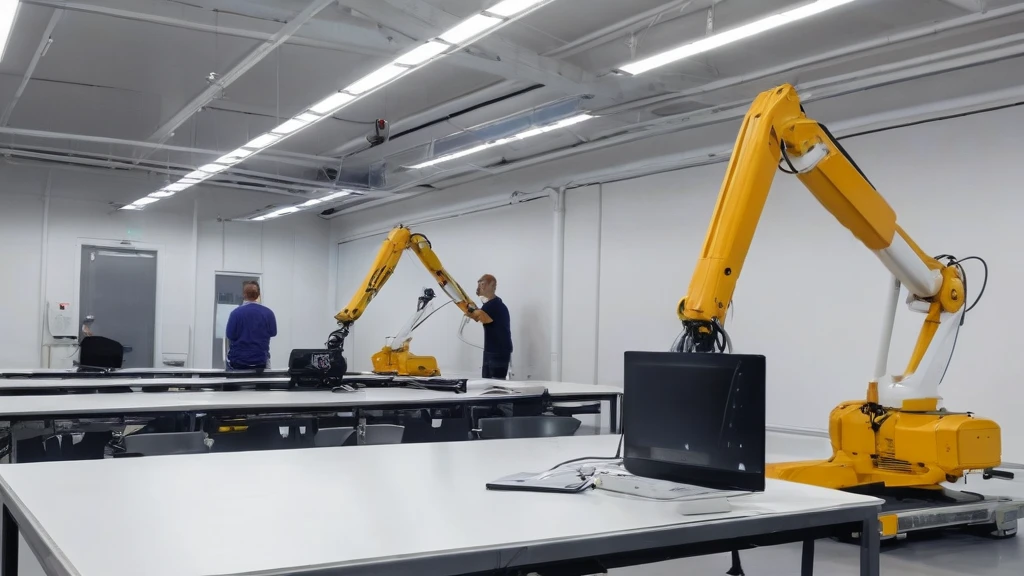
An important element of the project is its practical validation. Research and tests will be conducted in high-risk areas such as universities, data centers, and factories - places where safety and operational continuity are crucial. The project also has applications in the field of space exploration, which will utilize the ESA LUNA installation in Harwell as a test site for scenarios similar to those in an environment resembling outer space. As part of these tests, robots will perform tasks related to terrain mapping, threat detection, and real-time information transmission.
in real conditions - from weather changes to communication disruptions. The collaboration between the university and the integration company shows how academic research can be transformed into functional industrial solutions. Autodiscovery emphasizes that market demand for robots supporting infrastructure safety and inspection is growing - and this project aims to help deliver high-quality and scalable solutions. In the future, such systems may be used not only for monitoring but also for rapid response to disasters or technical failures.
Significance for industry and the future of autonomous robotics
The project showcases a key trend in robotics development: the transition from single devices to complex, cooperating systems. A team of robots can perform tasks faster and more efficiently than a single unit, and also offer greater resilience to failures - if one robot stops working, the others can continue the mission. This is especially important in difficult or dangerous environments for humans. In industry, where continuity of operation and safety are critical, such solutions can significantly reduce the risk of failure and increase inspection efficiency.
ym - without it Collaborative robots (cobots) limited. Although the project does not yet foresee full-scale industrial implementation, its results may serve as a foundation for further steps towards commercialization. It is worth emphasizing that although Autodiscovery supports hardware development and testing, this is not a final product or implementation - the project remains at the demonstration and pilot stage. Its significance lies in demonstrating the possibility of cooperation between multiple robots in real conditions, which may accelerate the development of standards and solutions for future autonomous systems.
Limitations and development prospects
Although the project is ambitious, its scope is limited to field tests and demonstrations of functionality. It does not yet foresee full commercialization or industrial-scale implementation. All results will be available only after the completion of the project, and its effectiveness will depend on many factors - from environmental conditions to the quality of software and communication. The lack of information about the duration of the tests or the number of experiments conducted limits the assessment of its effectiveness.
or the security of data transmitted between robots. It is also worth remembering that, despite the involvement of universities and an integration company, this is not a final product - the project is research and demonstration in nature. Its value lies in demonstrating the potential of robot teams in real conditions, rather than providing a ready-made solution for sale. Further development of such systems will depend on the development of communication standards, data security and software flexibility - all of which require long-term investment and cooperation between the public and private sectors.