Learn about the key advantages and benefits of technical consulting

Develop your business with a well-thought-out automation strategy

Technical consulting is not only assistance in choosing specific devices or solutions, but above all, support in building a comprehensive vision for the development of automation and robotics. At NexaRob, we combine knowledge from various fields - from mechanical engineering, through PLC controllers and vision systems, to issues related to the integration of collaborative robots. This interdisciplinary perspective helps us develop recommendations that not only address the current needs of the company but also provide a solid basis for further expansion.

Why technical consulting from NexaRob?

Thanks to professional technical consulting, companies gain confidence that their development path is refined in every detail, and the actions taken improve processes and open the door to further innovations.

Scope and model of cooperation with NexaRob in the area of consulting.

How does the consultation process work and what benefits does it bring to your company?

Technical consulting is a structured process in which NexaRob becomes a partner on the path to optimal use of automation technologies. In each collaboration, we strive to understand the unique challenges of a specific industry, the pace of change in the offer, or market requirements. Based on this, we formulate recommendations that bring measurable business results.

Initial state analysis.

Planning and recommendations.

Implementation and post-implementation support.

Ongoing cooperation and development.

By choosing technical consulting from NexaRob, you gain comprehensive support in shaping your company's technology strategy. We help you make informed investment decisions and create action plans that enable you to develop your offerings and maintain competitiveness in a dynamic economic environment.

Methods and tools - audit, ROI analysis and automation strategy

How does NexaRob identify areas for improvement and help companies plan profitable implementations?

A well-conducted advisory process is based on a thorough diagnosis of needs and the real capabilities of the company. At NexaRob, we use proven methods that enable us to provide precise analyses and formulate a comprehensive automation strategy. Thanks to this, our clients can safely and thoughtfully develop their production infrastructure and technological base.

Process and system audit

ROI (Return on Investment) analyses

Development of an automation strategy

Expert support and analytical tools

Audits and ROI analyses conducted in this way allow companies to make decisions about modernizations in a safe and well-considered manner, which not only improve daily operations but also open up opportunities for further, long-term development.

Examples of recommendations and industry consulting

Potential implementation scenarios for various industrial sectors

Although each company has its own specific characteristics and different goals, several recurring challenges can be identified that often arise during the automation of processes. Below we present selected examples of areas in which NexaRob's technical consulting helps to develop effective solutions - with the support of a global network of suppliers and taking into account safety principles and cost optimization.

Task: Improve washing and packaging processes to maintain high hygiene standards and reduce delivery times.

Recommendation: Implementation of collaborative robots in automated packaging lines, equipped with vision sensors for quality control of products. Supplemented with intelligent systems for monitoring the cleanliness of the line, which allows better management of downtime and maintenance.

Task: Increase the precision and repeatability of drug production processes and improve safety in sterile areas.

Recommendation: Use of robotic dispensing and packaging stations that minimize human contact with sensitive substances. Simultaneously integrate quality control systems using vision sensors, which speeds up the detection of any discrepancies.

Task: Improve ergonomics during the assembly of heavy components and reduce production cycle time.

Recommendation: Implementation of assistive manipulators and collaborative robots that take over repetitive and heavy assembly tasks. Additionally, integration of vision systems for automatic quality control of components and optimization of the flow of components on production lines.

Task: Increase the accuracy of assembling sensitive PCB components and maintain a constant level of electrostatic discharge (ESD) control.

Recommendation: Creation of automated assembly lines based on collaborative robots equipped with precision tools. Implementation of advanced micro-defect detection systems and the introduction of ESD solutions to protect delicate electronic components.

Task: Ensuring safe conditions during the production and packaging of chemicals with varying degrees of hazard.

Recommendation: Automation of areas exposed to contact with hazardous substances through the use of robotic systems in protective cabins. This reduces the risk for employees and maintains a high level of process control.

Task: Improving the quality of plastic product molding and eliminating defects that occur during the injection process.

Recommendation: Implementation of robots for automated removal of parts from injection molds and final assembly. Connection with vision systems enables quick detection of any shape imperfections.

Task: Streamlining the processes of cutting, welding, and machining metal components while maintaining high finishing quality.

Recommendation: Use of welding robots that provide precise and repeatable welds on various materials. Additionally, implementation of automated laser cutting and grinding stations, which effectively reduces the amount of waste.

Task: Reducing order fulfillment time while maintaining order in the warehouse and safety of operations.

Recommendation: Introduction of autonomous AGV carts for internal transport, supported by WMS systems to manage material flow. Collaborative robots can streamline loading and unloading, ensuring faster preparation of shipments.

Task: Ensuring uniform application of products, precise dispensing of ingredients, and attractive presentation of packaging.

Recommendation: Using collaborative robots for packing and capping containers, and introducing vision sensors to check the quality of labels and the tightness of packaging. This increases efficiency and reduces the number of production errors.

Task: Automation of packaging lines and increased flexibility in adapting package formats to different products.

Recommendation: Implementation of fast sorting systems and robots for forming, filling, and closing packages. Integration with vision sensors enables ongoing quality control, which translates into effective reduction of material losses.

Task: Efficient sorting and packaging of agricultural products while maintaining a high standard of hygiene in processing operations.

Recommendation: Application of automated selection systems that use vision sensors and collaborative robots to assess the quality of raw materials. This allows for precise rejection of products that do not meet standards, which minimizes losses and ensures consistent quality.

Task: Acceleration of prefabrication of building elements, material processing, and protection of workers from injuries.

Recommendation: Use of robots for assembly and machining of structural elements in a prefabrication environment. Integrated force and torque sensors enable precise drilling, cutting or welding, while ensuring safety when interacting with people.

Task: Raising quality and safety standards in the production of components for the aerospace industry and optimizing assembly and testing processes.

Recommendation: Introduction of high-precision robots supported by advanced vision systems and sensors for detecting micro-damage to materials. This allows errors to be eliminated at early stages of production, which is crucial in such a demanding industry.

Task: Automation of repetitive cutting, sewing and sorting operations while maintaining diversity of designs and sizes.

Recommendation: Installation of robots or collaborative machines for cutting and sewing materials with the support of pattern recognition systems. This enables maintaining production flexibility and consistent quality, even with frequent collection changes.

Task: Optimization of processes for cutting and assembling wooden and composite elements while reducing waste.

Recommendation: The use of robots and vision systems for the automatic positioning of furniture parts, which speeds up the assembly process and increases precision. This reduces the amount of material used in the prototyping process and the risk of mismatched components.

The proposals presented are only examples of areas in which NexaRob helps companies develop modern and effective automation solutions. By cooperating with a global network of suppliers and relying on an interdisciplinary team, we can adapt the selection of technologies to individual needs - regardless of the size of the company or industry. Thanks to this flexible approach, we help businesses improve processes, increase safety and improve operational efficiency.

Tools and Best Practices in planning a long-term technological vision

How to develop a coherent automation strategy that keeps pace with market changes

Long-term success in automation is not limited to the implementation of a new production line or the purchase of a collaborative robot. It is crucial to look at the entire industrial environment as a system in which selected technologies and work methods complement each other. NexaRob supports companies in building such a vision - flexible, yet resilient to changes in the industry.

Defining main goals and indicators

Evaluation of industry trends

Flexible investment planning

Maintaining continuity and developing team competencies

Building a coherent technological vision requires a good understanding of the potential and limitations of available solutions, as well as the ability to skillfully predict market changes. NexaRob accompanies companies at every stage - from initial trend analysis, through planning and implementation, to continuous development of the adopted strategy.

Cost optimization and sustainable development in technical consulting

How thoughtful technology choices support savings and social responsibility

Decisions regarding automation and robotics are increasingly having not only an economic dimension, but also an ecological one. Investments in modern technologies can significantly reduce energy consumption while increasing the efficiency of production lines. At NexaRob, we strive to combine these two perspectives in order to advise on solutions that bring benefits to both the company and the environment.

Real reduction of operating costs

Adapting to market and environmental trends

Increasing flexibility and safety

Actions for social responsibility (CSR)

The use of sustainable automation technologies not only reduces costs and improves process efficiency, but also increases the attractiveness of the company in the eyes of customers and partners. NexaRob Consulting combines business goals with social responsibility, creating a foundation for stable growth in a rapidly changing market environment.

Answers to questions related to technical consulting and cooperation with NexaRob.

Frequently Asked Questions

Below we present nine questions that often arise during the planning of consulting services. If you cannot find answers to your doubts here, please contact us - we will be happy to discuss the details and present solutions tailored to your business profile.

Definitely yes. Even in small companies, the introduction of well-planned automation can bring significant savings and improve the organization of work. NexaRob flexibly adapts the scope of consultations to the size of the company, budget and business goals.

The duration depends on the complexity of a given project. We usually start with a short analysis (several days or weeks), and then we present an implementation plan. If multi-stage improvement of production lines is required, the process may extend over several months, but each stage is clearly defined.

We attach great importance to maintaining business secrecy. Before starting work, we sign a non-disclosure agreement, and the collected technical and organizational information is used only to develop personalized recommendations.

No. We are a solutions integrator, which means that we cooperate with suppliers of various technologies - from collaborative robots, through PLC controllers, to vision systems or MES/ERP class software. We select them based on the actual needs of the client.

Our consulting services are modular: each proposal can be implemented in its entirety, or you can choose the elements that you consider a priority at any given time. We also provide assistance in developing a schedule for future investments.

Yes. We can participate in the implementation of suggested changes, act as a consultant during the project, or monitor the results on an ongoing basis. We tailor the collaboration model to the client's expectations.

We work closely with technical staff to understand real challenges and improve existing procedures. This allows us to create recommendations that address actual problems, not just theoretical assumptions.

Depending on the nature and scope of the project, we can help find appropriate support programs or contacts with financing institutions. We strive to identify paths that will facilitate the implementation of investments within available public funds or business partnerships.

We begin the entire consulting process by establishing a clear scope of work and an approximate budget. During the project, we inform you of any changes or the need to expand services. This way, you know what costs to expect and what results you will get in return.

Do you have more questions?

We invite you to contact NexaRob. We will be happy to answer any questions and tell you how our consulting can help your company effectively utilize the potential of innovative automation technologies.
Automate Your Business with NexaRob - Contact Us!

Interesting facts from around the world

GAM: a new basic model for robotic manipulation in industry.

Amazon introduced the Generalized Action Model (GAM) - an advanced foundational model for robotic manipulation, which
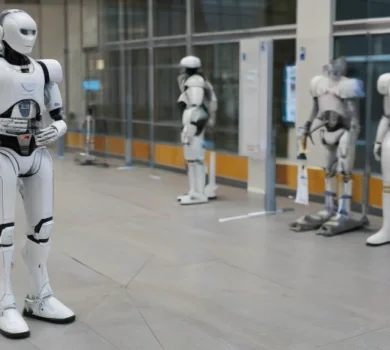
Fraunhofer IPA presents robotics for the circular economy at the European Parliament

On September 2, 2026, the Fraunhofer Institute for Manufacturing Engineering and Automation IPA (IPA)
A new method helps people predict errors in self-driving cars

Researchers from MIT and Motional have developed a system that allows people to predict errors in self-driving cars.
How intelligent memory coding can save energy in autonomous vehicles

A new method called MotiMem-Omega can reduce energy consumption in the memory interface of an autonomous vehicle by
KEENON unveiled the KOM 3.0 at WRC 2026: robots think before they act

At the World Robot Conference 2026, KEENON Robotics presented KOM 3.0 - a new generation of AI architecture,

English (United States)EN-US