
Choose the optimal robot design so that your implementation brings maximum benefits

Learn about the Main Types of Robots and Their Key Differences

On this subpage, we present comparisons of various types of industrial robots, such as articulated robots, SCARA, Cartesian, Delta, or collaborative robots (cobots). Our goal is to help you understand the most important design differences, working range, and applications so that you can make an informed choice of technology best suited to the processes carried out in your company.

Each type of robot has its unique advantages as well as certain limitations that may have a significant impact on the performance and efficiency of future implementation. At NexaRob, we believe that only a reliable comparison of available solutions and understanding the needs of a specific enterprise allow for planning optimal automation. Therefore, in addition to a general description of each type of robot, we have prepared a comparative table in which we have compared key parameters.

By using the content on this page, you will learn, among other things:

Thanks to this guide, you will gain a solid knowledge base that will facilitate your discussions with suppliers and decision-making related to the robotization of processes in your plant.

Discover six popular categories of robots - from articulated to mobile.

Main Types of Robots and Their Key Features

There are many types of industrial robots available on the market, and choosing the best solution depends on the nature of your processes. Below we present six main designs, along with links to more detailed descriptions:

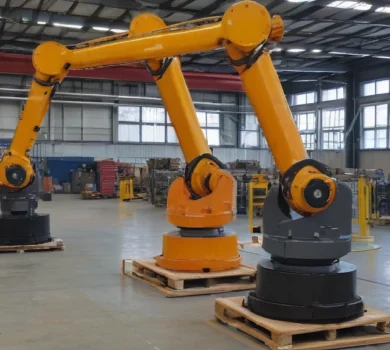
Multi-axis robots with high motion flexibility. Ideal for welding, assembly, and tasks requiring movement in multiple planes.

Fast and precise operations with a limited range in the vertical axis. Recommended for assembling lightweight components, pick-and-place applications, or use in the electronics industry.

A design based on movement in three mutually perpendicular linear axes. Often chosen for 3D printing, processing of lightweight materials, and simple pick-and-place operations.

High-speed parallel robots Primarily used in packaging, sorting, and the food industry for handling lightweight parts.

Designed for safe operation in close proximity to people. They are suitable for a variety of assembly applications and small production lines.

Autonomous mobile robots (AMRs) or automated guided vehicles (AGVs) Used in logistics, warehousing, and high-throughput production lines.

Each of these designs has its strengths, so it is important to match the chosen solution to the specifics of your plant and the intended application. In the following sections, you will find more information on how different types of robots perform in specific industries and what tasks they can perform most effectively.

Six examples of industries and processes where industrial robots bring the greatest benefits.

How to Choose a Robot for Your Sector

Different branches of industry have different requirements regarding safety, hygiene or the nature of work. Below we present six example applications in various industries, along with links to dedicated sections where we discuss them in more detail:

Example tasks: Product packaging, sorting fruits and vegetables, palletizing at the end of the line.

Example tasks: Dispensing medicines, labeling ampoules, quality control in sterile conditions.

Example tasks: Welding body parts, assembling components, operating machines on production lines.

Example tasks: Soldering components, assembling PCBs, testing and quality control of electronic devices.

Example tasks: Precise dispensing of substances, mixing ingredients, working in an aggressive chemical environment.

Example tasks: Operating injection molding machines, forming parts, sorting and packaging plastic products.

Example tasks: Welding heavy elements, cutting sheets, transporting loads at high temperatures.

Example tasks: Automated pallet transport, order picking, sorting of packages and loads.

Example tasks: Gentle dispensing of creams, packaging of bottles, labeling of containers.

Example tasks: Forming cartons, automatic closing and labeling of boxes, palletizing finished packages.

Example tasks: Harvesting plants, sorting agricultural produce, preliminary processing of food raw materials.

Example tasks: Mixing mortars, moving heavy blocks, prefabrication of structural elements.

Example tasks: Precise assembly of components, leak tests, machining of high-strength materials.

Example tasks: Automatic cutting of fabrics, sewing garment elements, checking patterns and dimensions.

Example tasks: Processing furniture boards, assembling cabinets and tables, varnishing wooden surfaces.

How to use this information?

Consider which processes in your plant would benefit most from automation - whether due to high labor costs, quality requirements, or strict safety and hygiene standards. Then go to the appropriate subpage (e.g., Food Industry) to learn more about typical implementations and see what types of robots (e.g., articulated, SCARA, Cartesian) are most commonly used. This will make it easier for you to select solutions that will bring the greatest value to your company.

A simple comparison of the most important features - check which type of robot best suits your needs.

Key Parameters and Characteristics

Below is a comparative table that compares the main parameters and applications of popular designs: articulated robots, SCARA, Cartesian, Delta, collaborative (cobots) and mobile (AMR/AGV). The table will help you quickly assess the key differences and understand in which conditions a given type of robot will perform best.

Scroll the table to the side to see all columns.

Parameter SCARA Articulated Cartesian Cobots Delta Mobile (AMR/AGV) Cylindrical Gantry
Advantages Speed, compactness Versatility, large range of motion Stability, high precision Safety, easy integration Speed with light loads Mobility, transport automation Stability in axial movements Handling large loads
Disadvantages Limited range of motion Higher cost, maintenance Large sizes Limited speed, lower force Limited precision with larger loads Does not operate in harsh conditions Lack of flexibility outside the axis Limited speed, complicated installation
Typical applications Assembly, packaging Welding, manipulation Cutting, machining Working with people, precision assembly Sorting, packaging Internal transport, logistics Servicing axial processes Moving large elements
Cost Medium High Low Medium Medium Medium Low High
Load capacity 1-20 kg 10-300 kg 5-100 kg 1-15 kg 3-10 kg 50-200 kg 10-80 kg 100-500 kg
Arm reach 300-800 mm 500-3000 mm 500-4000 mm 400-1000 mm 1000-1500 mm Not applicable 1000-2000 mm 3000-5000 mm
Cycle time 0.3-1.0 s 1.0-3.0 s 2.0-5.0 s 1.0-2.0 s 0.3-0.7 s Not applicable 1.5-3.0 s 4.0-6.0 s
Lifespan 40,000-60,000 h 50,000-70,000 h 30,000-50,000 h 30,000-40,000 h 35,000-50,000 h 40,000-70,000 h 35,000-50,000 h 60,000-80,000 h
How to read the table:

Thanks to this comparison, you will more easily decide which type of robot meets your requirements regarding performance, payload, or precision level. In the following sections, we will present practical tips on when a given design is the best choice and when it is worth considering alternatives.

Learn about six key factors that influence the decision to choose a specific type of robot.

When to Choose a Specific Design and When to Consider an Alternative

Each type of robot has its strengths and weaknesses. Whether it will work in your plant depends on the specifics of the processes, expected performance, available budget, and environmental conditions. Below, we highlight six basic criteria that will help you understand the advantages and limitations of different designs:

Range of Motion and Flexibility

Articulated robots provide versatile movement in multiple planes but can be more complex to program.
SCARA and Delta offer high speed with lighter loads but have limited flexibility in vertical axis movement.

Payload and Reach.

If you are planning to move heavy objects (e.g., in the metal industry), an articulated or gantry robot may be necessary.
Delta and SCARA robots are ideal for smaller loads where short cycle times are important.

Safety and Working with People

Cobots are the best choice when a robot is intended to work directly with an employee. In traditional designs (articulated),
SCARA) often requires a safety zone, i.e., fencing or sensors.

Ease of Programming and Integration

Cartesian (XYZ) robots can be simpler to configure trajectories, which can speed up implementation in linear processes.
In articulated and mobile robots, the level of programming complexity may be higher, but they offer greater flexibility.

Purchase and Maintenance Costs

Simple designs, such as Cartesian robots, often have lower investment and operating costs.
Advanced robots, e.g., articulated robots with a large payload capacity, involve higher prices and a longer payback period, but can handle complex tasks.

Working Environment and Industry Standards

In the food, chemical, or pharmaceutical industry, the robot must meet strict hygiene and safety requirements (e.g., easy-to-clean housing, resistance to substances).
In heavy industry (metal, steel), resistance to high temperatures, dust, and the ability to work in harsh conditions are important.

When to choose a specific type?

Keep in mind that the ideal choice also depends on the planned applications and the industry you operate in. You can check this by visiting Industries or Robot Applications. If you have any questions, we will be happy to advise you on selecting the appropriate technologies and estimating the return on investment.

Simple tips to help you smoothly transition from concept to industrial robot deployment.

How to Match Robot Type to Infrastructure and Needs

Even the best-chosen type of robot may not deliver the expected results if the implementation planning is carried out in a chaotic manner. Below are six key guidelines that will help you effectively match the robot type to your existing infrastructure and the specifics of your company:

Thorough Process Analysis

Adaptation to Environmental Conditions

Integration with Existing Systems

Development Plan and Scalability

Safety and Work Zones

Well-planned Logistics and Service

With these tips, you will plan the implementation step by step, minimizing the risk of unforeseen costs and delays. If you need individual consultation, we will be happy to help you develop a detailed automation strategy - from process analysis to robot integration with your system.

Do you have questions about choosing robots? Check what our customers are most interested in.

Frequently Asked Questions

Often yes, especially if you choose a universal (multi-task) robot or a design with a flexible reach. However, sometimes it is worth having different robots in different areas to achieve maximum efficiency.

It depends on the scale of production, labor costs and the type of tasks. Often, ROI can be seen within 1-2 years, especially when automation significantly increases productivity.

Yes, as long as they handle an appropriate weight range and operate in conditions that meet hygiene requirements. If a very short cycle time is needed in packaging, it is also worth considering Delta robots.

Usually, gentle handling of products and fast packaging are important. Many companies choose Delta, SCARA or cobots equipped with adaptive grippers.

Collaborative robots generally have a lower load capacity and movement speed for safety reasons, but they can still significantly facilitate many assembly or packaging tasks.

Fencing, motion sensors, light curtains and emergency shutdown procedures are used. Everything depends on the risk assessment and standards (e.g., ISO 10218).

Do you have more questions?

If you want to know more answers, visit our extended FAQ section or contact our team. We will be happy to answer questions about Industries, Applications or Types of Robots, and also help in selecting optimal solutions for your requirements. Choosing the right technology is the first step towards effective automation and competitiveness in today's market.


Automate Your Business with NexaRob - Contact Us!

Global presence, local precision - NexaRob supports companies worldwide.

We operate globally, support locally

At NexaRob, we combine global trends with local knowledge to provide reliable and accurate comparisons of robot types. Our global network of experts enables us to analyze the latest solutions from different regions, and local support ensures that each recommendation is tailored to specific market needs. This allows us to help our customers make informed investment decisions in the area of automation.

United States
China
Japan
Germany
India
United Kingdom
France
Italy
Canada
South Korea
Brazil
Australia
Spain
Mexico
Indonesia
Netherlands
Saudi Arabia
Turkey
Switzerland
Taiwan
Poland
Sweden
Belgium
Thailand
Ireland
Austria
Norway
Israel
United Arab Emirates
Argentina
South Africa
Denmark
Philippines
Singapore
Malaysia
Colombia
Bangladesh
Egypt
Chile
Finland
Vietnam
Portugal
Czech Republic
Romania
New Zealand
Peru
Greece
Ukraine
Slovakia
Hungary
Slovenia
Croatia
Serbia
Bulgaria
Estonia
Latvia
Lithuania
Iceland
Luxembourg
Malta
Cyprus
Morocco
Algeria
Tunisia
Nigeria
Kenya
Ethiopia
Ghana
Tanzania
Uganda
Angola
Senegal
Qatar
Kuwait
Oman
Pakistan
Sri Lanka
Nepal
Kazakhstan
Uzbekistan
Mongolia
Russia
Cambodia
Myanmar
Laos
Fiji
Papua New Guinea
Venezuela
Ecuador
Uruguay
Paraguay
Bolivia
Costa Rica
Panama
Dominican Republic
Guatemala
Cuba
Jordan
Lebanon
Iran

Together we create the future of automation.

Do you want to become our Partner?

At NexaRob, we believe that collaboration is the foundation of innovation. If you value reliable analysis and a modern approach to automation, we invite you to partner with us. Our robot type comparisons are created in cooperation with leading manufacturers, system integrators, and technology experts, which translates into unique, practical solutions for your business.

Why is it worth cooperating with NexaRob?

Join the NexaRob partner network and together let's create the future of automation.

We invite you to contact us - together we can achieve more by creating innovative solutions that set new standards in the robotics industry.

Interesting facts from around the world

Cruzr Y1: a new industrial humanoid robot from UBTECH with an autonomous agent.

UBTECH presented a new model of an industrial humanoid called Cruzr Y1, which is to be used in...

How are robots changing industry and services in 2022? Five key trends.

In 2022, the global stock of industrial robots exceeded 3 million units, and the growth rate...

The UK is losing ground in global automation - robot sales fell by 3% in 2018.

In 2018, installations of industrial robots in the UK fell by 3 percent - for the first time.

Humanoid robots: between vision and reality - a new report from IFR.

The International Federation of Robotics (IFR) has published a new position paper that analyzes the real prospects for the development of humanoid robots.

Robots help achieve the UN's sustainable development goals.

Robots are not only changing the way products are manufactured, but also contributing to the achievement of sustainable development goals.

English (United States)EN-US