
The first robotics program at an elite engineering school
The University of Michigan not only introduced one of the first undergraduate robotics programs in the United States, but it did so at one of the best engineering schools. The program, which has focused on practice and modern technologies from the very beginning, is developing dynamically - already in 2024, more than 175 students have declared their participation. This is not just a number, but a testament to the growing popularity of a field that combines engineering, computer science, and human-machine interaction.
The program is not limited to theory. Students learn from the basics - from environmental perception to real-time decision making - and then customize their degree with 18 points for technical subjects. This gives them the opportunity to focus on specific areas, such as motion control, autonomous robotics, or human-robot interaction.
Practical experience with 300+ MBot robots
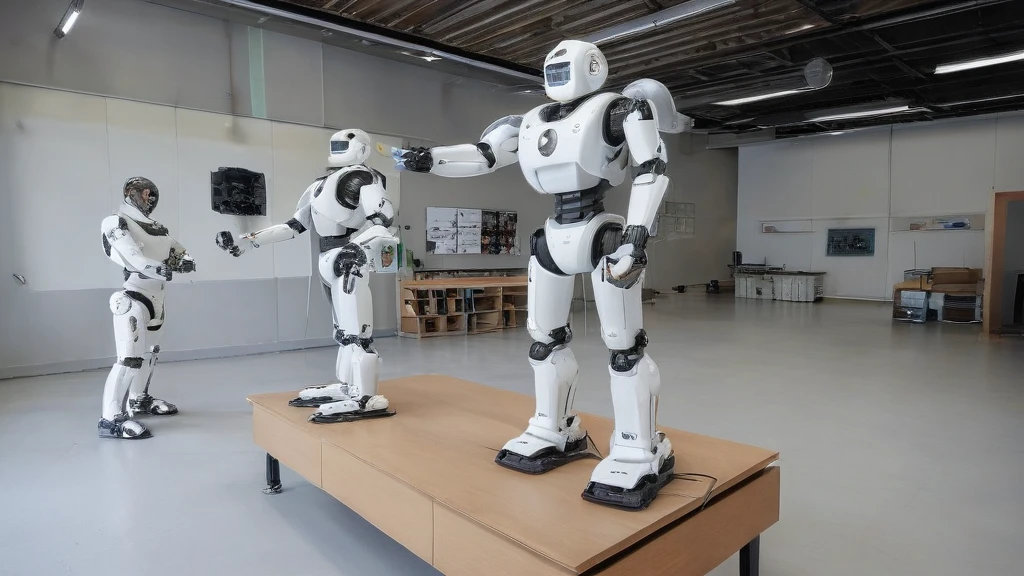
An important element of the program is access to over 300 MBot robots, which support classes. These devices are used both in introductory classes and in final projects. For example, a student demonstrates the movement of a three-legged robot outside the laboratory, and an MBot Omni waits for instructions in room ROB 102 - an introduction to programming and artificial intelligence.
Thanks to this, students not only learn to code, but also understand how a robot works in the real world. The program also supports tests on Mars Yard - an area simulating the surface of the planet - which shows that the field has real applications even outside the laboratory.
Research and competitions as part of education
 Enlarged imageClose zoomPrevious image
Students have access to a range of research programs that allow them to gain real-time experience. The SURE program offers paid summer science experiences under the supervision of professors, and UROP enables research work throughout the academic year with compensation.
In addition, students often devote a large part of their time to team projects. Similar to FIRST Robotics, teams work on designing robots and participate in international competitions - for example, in the HockeyCup robotic soccer tournament or projects in the field of medical robotics. This not only develops technical skills, but also communication and teamwork skills.
Career after graduation: from NASA to Tesla
A degree in robotics from the University of Michigan opens doors to a wide range of industries. Graduates work at companies such as Amazon Robotics, SpaceX, Google, Ford Motor Company, NASA and Stryker - both in the USA and abroad.
The program also offers the possibility of accelerated master's studies through the SUGS program, which allows students to obtain a bachelor's and master's degree in five years. This gives students a significant competitive advantage in the job market.
The first robotics program at an elite engineering school
The robotics program at the University of Michigan is not only a breakthrough in engineering education but also plays a key role in shaping the future of technology. As one of the first undergraduate programs in the United States, it was designed to integrate theory with real-world application. Students not only learn the basic principles of robot operation - such as environmental perception and real-time decision-making - but also develop adaptability and innovation skills. With the ability to choose 18 credits for technical subjects, each student can tailor their educational path to specific interests, such as autonomous robotics, human-robot interaction, or embedded systems. This allows them to develop specializations from the very beginning of their studies, which is crucial for preparing them for the complex challenges of today's job market.
The program is not limited to classrooms and laboratories - its philosophy is based on the principle of "learning by doing." Students are involved in real-world projects that have an impact beyond the university. An example is Mars Yard - an area simulating the surface of Mars, where teams test rover prototypes, simulating extreme conditions. This experience not only develops technical skills but also creativity and problem-solving abilities under constraints. In this way, the program transforms a student from a learner into an engineer ready to work on real research and industrial projects.
Practical experience with 300+ MBot robots
Access to over 300 MBot robots is not just a number - it is the foundation of practical education. Each of these devices is used in various stages of learning: from introduction to programming and artificial intelligence, through designing control algorithms, to final tests under conditions close to reality. In room ROB 102, where the MBot Omni awaits instructions, students learn not only to code but also to understand the interactions between the robot and the environment. An example is a three-legged robot demonstrating movement outside the laboratory - it signals that learning goes beyond the boundaries of traditional classes.
An important aspect is also the development of teamwork and project management skills. An example is projects like "HockeyCup", where teams create robots to play soccer, which requires collaboration between programmers, mechanical engineers, and specialists in decision-making algorithms. Such experience is extremely valuable in the job market, where communication, organization, and conflict resolution skills within a team are key. Therefore, the program not only trains technicians but also future leaders.