

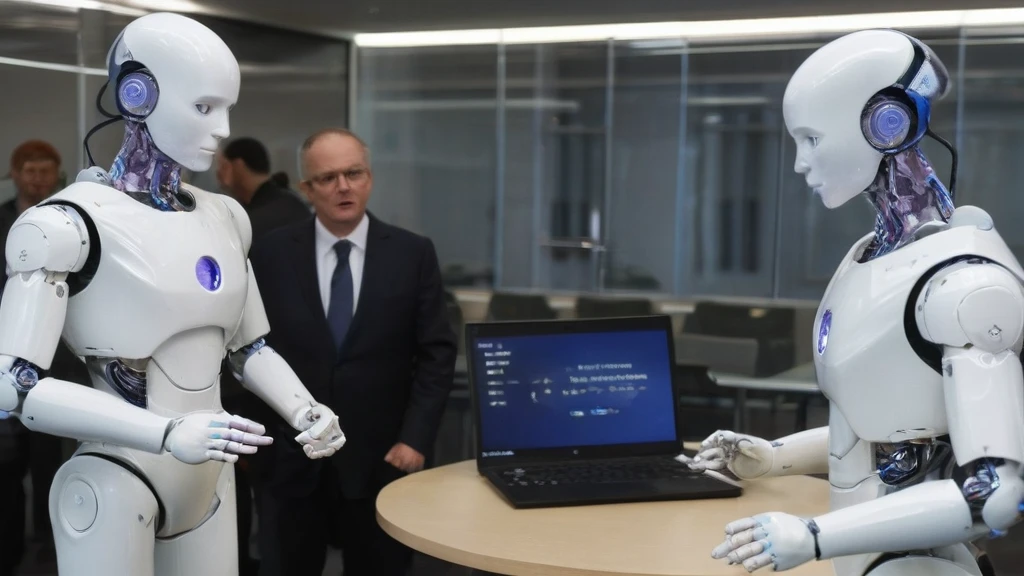
Demonstration of a leading researcher on the political stage
On September 2, 2026, the European Parliament in Brussels became a place where science met politics. Fifteen advanced robotic systems powered by artificial intelligence demonstrated how far technology has come in Europe. The demonstration was part of the euROBIN initiative - a European research network connecting robotics and AI laboratories - and aimed to show that Europe not only leads in research but can also transform it into real solutions. Among the participants were representatives from governments, industry and academic institutions - all interested in the continent's technology strategy.
The event was more than just an exhibition. It was a clear message: Europe has the potential to achieve technological sovereignty in the field of robotics. The modern systems showcased included solutions for cyclical production, autonomous logistics, and robots assisting people in everyday situations. These are not futuristic hypotheses - they are already working prototypes that demonstrate that the technology is ready to move from laboratories to the market.
Germany as an engine of European robotics
 Enlarged imageClose zoomPrevious image
The demonstration in Brussels clearly showed how German institutions are a key element of the European robotics ecosystem. DLR, KIT, Technical University of Munich (TUM), Fraunhofer IPA, and Bremen University - all these organizations contributed to the preparation of the systems presented at the political arena. Their participation is not accidental: it is in Germany that one of the most advanced research structures in Europe is developing - Robotics Institute Germany (RIG).
Among the solutions presented was humanoid the Rollin’ Justin robot from DLR, which demonstrated its ability to perform complex movements and interact with the environment. Researchers from TUM and Bremen University also presented a two-arm robotic system designed for industrial tasks - an example of how collaboration between a university and an institute can lead to highly functional solutions. This is not just technology - it is a model of cooperation that can be scaled at the European level.
From research to real-world applications
The event in Brussels was more than just a showcase of possibilities. It was a call to action - for both public and private institutions. Alin Albu-Schäffer, director of the DLR Institute of Robotics and Mechatronics and coordinator of euROBIN, emphasized: 'Now we need to transform this strength into an industrial scale and widespread implementation.' This is not just about technology - it is about investment. About the need to build specialized infrastructure, flagship platforms, and a long-term research strategy.
Tamim Asfour, speaking on behalf of RIG and head of the H²T Lab group at KIT, noted: "This was a strong signal of what the European robotics community can achieve together." His words emphasize that the future lies not in isolated projects, but in integrated research networks. It is also worth remembering that these are not just declarations - the demonstration showed that the technology already exists. Now it needs to be supported.
What's next? The future of European robotics.
The event in Brussels does not mark the end, but the beginning of a new phase. European robotics now has the opportunity to transform its research leadership into economic competitiveness. However, this requires real investment - not only in projects, but also in infrastructure, training and test platforms. Without this, even the most advanced prototypes may be stuck at the laboratory stage.
It is also worth remembering the limitations: the demonstration concerned specific systems that were not fully scalable or commercially available. There is no talk of mass deployment here - only of demonstrating potential. The future depends on whether Europe will be ready to invest in this potential with appropriate speed and effectiveness.
The future of European robotics does not depend only on technology, but also on political will and a strategic approach. The demonstration in Brussels was one of the first steps towards building a common innovation platform at the continental level - one that would allow for a faster transition from prototypes to commercialization. The development of test infrastructure is also crucial, such as testing grounds for autonomous robotics or research centers specializing in AI and human-robot interaction. Without such structures, even the most advanced solutions may be stuck at the experimental stage. It is also worth emphasizing that success will not be possible without cooperation between countries - especially in the context of harmonizing standards, regulations and public investments. European robotics has the potential to become a strong element of the digital economy, but only if the strategy is consistent with market realities and industry needs.