
How does ARTiS solve the problem of robots holding tools?
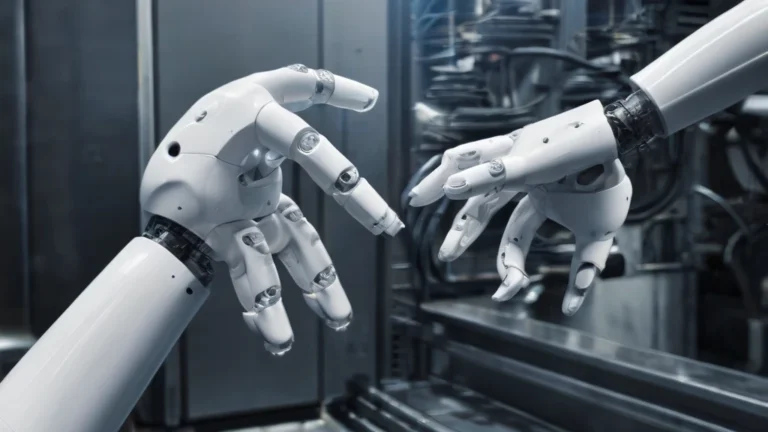
In disassembly processes, where precision and reliability are key, a robot holding a tool is one of the biggest challenges. Grippers that are too rigid cannot handle the variety of shapes, while those that are too soft often do not provide sufficient grip strength. ARTiS was created specifically in response to this difficulty - as a new gripper concept combining the flexibility of soft systems with the strength of rigid mechanisms. This allows it to safely and stably hold tools of various shapes, sizes and surfaces.
The key to its operation is a unique combination of two technologies: active jamming in the hand and fin-ray adaptation in the fingers. Active jamming allows for rapid increase in hand hardness, which ensures a solid grip even with minimal pressure. In the fingers, a fin-ray structure is used - flexible, fin-like elements that can deform and adapt to the surface of the tool, ensuring precise contact.
This hybrid design allows for a compromise between flexibility and durability, which is crucial in industrial environments where tools vary in shape, weight, and surface. ARTiS not only holds the tool but can also precisely position it, thanks to seven degrees of freedom in its fingers.
Why are seven degrees of freedom key to precision?
 Enlarged imageClose zoomPrevious image
ARTiS not only holds the tool but can also precisely position it. This is possible thanks to seven degrees of freedom in its fingers, which enable any orientation of the end effector. In practice, this means that the gripper can adapt to the angles and curves of tools even in hard-to-reach places, which is crucial in disassembling equipment with a complex structure.
This type of motion mechanism allows for performing both automated tasks and collaborative work with humans. In human-assisted systems, the gripper can smoothly adapt to the changing needs of the operator, which significantly improves ergonomics and workplace safety.
Seven degrees of freedom not only enable precise adjustment of the end effector to the tool's surface but also control the angles of inclination and rotation during manipulation. This allows for performing tasks that require precision, such as screwing screws in hard-to-reach places or performing operations in a limited space.
What were the results of the tests and why is this important?
Studies conducted on various types of disassembly tools - from screwdrivers to pipe wrenches - confirmed that ARTiS works effectively in diverse conditions. The evaluation included durability, grip compliance, and functional diversity. All tests showed high device reliability, which suggests its potential for practical application in industry.
It is important that these results are based on real tests, not just simulations. Although the gripper has not yet been implemented in production, its acceptance for publication in TASE (IEEE Transactions on Automation Science and Engineering) is an important step towards real implementation. This means that its design has been evaluated by experts and recognized as a significant contribution to development. of industrial robotics.
Tests have confirmed that ARTiS can safely hold tools of various shapes and surfaces, and its adaptive fin-ray fingers provide a stable grip even with changing pressure or angle. In addition, the system demonstrated high resistance to wear during cyclic operations.
Is ARTiS already ready for use in factories?
For now, ARTiS is not a commercial product nor has it been implemented in real production systems. Its status is an expert-confirmed research concept that has been accepted for publication in the prestigious TASE journal. This means that the project is recognized as valuable and innovative, but it has not yet been transformed into a commercial solution.
For robotic technology integrators such as NexaRob, ARTiS represents an interesting example of new approaches to the gripping problem. It can be used as inspiration when designing systems for specialized disassembly tasks - especially where traditional grippers cannot handle the variety of tools.
In the future, it may be implemented in automated disassembly systems, especially in sectors where high precision and flexibility are required. Its hybrid design may become the basis for new generations of grippers designed for specialized tasks.